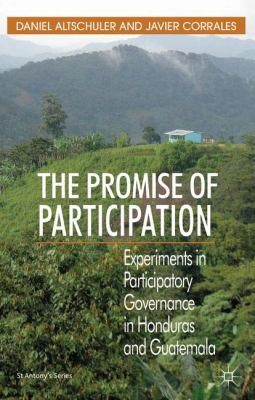
The Promise of Participation: Experiments in Participatory Governance in Honduras and Guatemala
0
0
As an Amazon Associate and affiliate partner, Menrva Books earns from qualifying purchases. Learn more
Author Description
Political scientists have long wondered whether civic participation can have spillover effects - that is, whether civic participation in one particular domain of public life can lead to more participation in other areas. This book argues that participation can indeed be generative. New participants in participatory governance initiatives can acquire new skills, apply them to new areas of their lives, and join new organizations, even in very poor regions. The evidence is based on a large survey - among the broadest in its class - of participants in community-managed schools (CMS) in rural Honduras and Alta Verapaz, Guatemala, together with case studies and historical institutional analysis. This study is thus more optimistic about the promise of participation than other studies. While it recognizes that participatory arenas are often constrained by features of program design, local context, and national political problems, this book shows that participation is not a dead-end affair. Participation can breed new and unexpected forms of civicness, even in the most unlikely settings
Menrva's Summary
THE THESIS
This book investigates whether civic participation in one area of public life can foster greater participation in other domains. It argues that participation is generative, enabling individuals in even impoverished regions to acquire new skills, apply them broadly, and join new organizations. The study draws on extensive survey data from participants in community-managed schools in rural Honduras and Guatemala, supplemented by case studies and historical institutional analysis, to present a more optimistic view of participation's potential.
THE SCOPE MAP
- Analysis of spillover effects of civic participation.
- Evidence from a large-scale survey of participants in community-managed schools in Honduras and Guatemala.
- Case studies and historical institutional analysis of participatory governance.
- Exploration of how participation can foster new skills and civic engagement in resource-poor settings.
- Discussion of constraints on participatory arenas, including program design, local context, and national politics.
- An optimistic perspective on the promise and potential of participatory governance.
THE AUTHORITY PERSPECTIVE
The book presents a hopeful argument for the generative nature of civic participation, even in challenging socio-economic contexts. It is likely to be of interest to scholars and practitioners focused on democratic governance, community development, and Latin American politics. The research methodology, combining broad survey data with qualitative analysis, aims to provide robust evidence for its claims. The work suggests that despite inherent limitations, participatory initiatives can indeed cultivate unexpected forms of civic engagement.
Page Count:
247
Publication Date:
2013-01-01
ISBN-10:
1137271833
ISBN-13:
9781137271839
Non-Fiction
Science
History
Politics
Art
Community Development
Governance
Community Tags
Similar Books