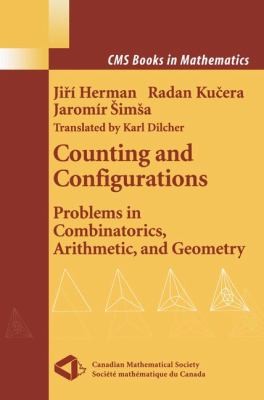
Counting and Configurations Problems in Combinatorics, Arithmetic, and Geometry
0
0
As an Amazon Associate and affiliate partner, Menrva Books earns from qualifying purchases. Learn more
Author Description
This book presents methods of solving problems in three areas of elementary combinatorial mathematics: classical combinatorics, combinatorial arithmetic, and combinatorial geometry. In each topic, brief theoretical discussions are immediately followed by carefully worked-out examples of increasing degrees of difficulty, and by exercises that range from routine to rather challenging. While this book emphasizes some methods that are not usually covered in beginning university courses, it nevertheless teaches techniques and skills that are useful not only in the specific topics covered here. There are approximately 310 examples and 650 exercises. Jirí Herman is the headmaster of a prestigious secondary school (Gymnazium) in Brno, Radan Kucera is Associate Professor of Mathematics at Masaryk University in Brno, and Jaromír Simsa is a researcher at the Mathematical Institute of the Academy of Sciences of the Czech Republic. The translator, Karl Dilcher, is Professor of Mathematics at Dalhousie University in Canada. This book can be seen as a continuation of the previous book by the same authors and also translated by Karl Dilcher, Equations and Inequalities: Elementary Problems and Theorems in Algebra and Number Theory (Springer-Verlag 2000).
Menrva's Summary
THE THESIS
This book presents methods for solving problems in three areas of elementary combinatorial mathematics: classical combinatorics, combinatorial arithmetic, and combinatorial geometry. It offers brief theoretical discussions followed by carefully worked-out examples of increasing difficulty and a range of exercises. The text emphasizes techniques not typically found in introductory university courses, aiming to impart skills applicable beyond the specific topics covered. The book is a continuation of a previous work by the same authors on algebra and number theory.
THE SCOPE MAP
- Coverage of classical combinatorics principles.
- Exploration of combinatorial arithmetic techniques.
- Introduction to combinatorial geometry problems.
- Numerous carefully worked-out examples, approximately 310.
- Extensive exercises, approximately 650, ranging from routine to challenging.
- Focus on methods not usually covered in beginning university courses.
- Skills developed are useful beyond the specific topics presented.
THE AUTHORITY PERSPECTIVE
This book is presented as a continuation of a previous work by the same authors, suggesting a cohesive approach to mathematical problem-solving. The structure, with theoretical discussions followed by graded examples and exercises, indicates a pedagogical focus designed to build skills progressively. The emphasis on methods beyond typical introductory courses suggests it aims to engage students and professionals seeking a deeper understanding of combinatorial mathematics. The inclusion of a significant number of examples and exercises points to a resource intended for active learning and practice.
Page Count:
392
Publication Date:
2010-01-01
ISBN-10:
1441930531
ISBN-13:
9781441930538
Science
Non-Fiction
Arithmetic
Combinatorics
Mathematics
Geometry
Community Tags
Similar Books