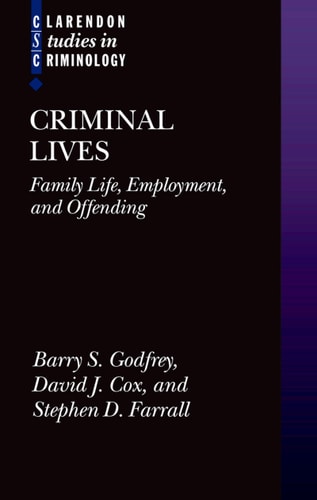
Criminal Lives: Family Life, Employment, and Offending
0
0
As an Amazon Associate and affiliate partner, Menrva Books earns from qualifying purchases. Learn more
Author Description
There is currently a huge growth of interest in histories of crime, and intellectual conversations and connections between historians and criminologists are becoming much more frequent. However, published work which uses historical data to this extent is rare. Criminal Lives uses historical data to directly address modern criminological debates and engages a wide audience in a genuinely interdisciplinary analysis.This book addresses a number of important questions about offenders' persistence in, or distance from, crime and questions the current theoretical frameworks that are given to explain why some people stop, or slow down, their offending, and why offenders' children become involved in crime. By using criminal registers, census material, and newspaper reports from 1880 -1940 for one industrial town in North-West England, this book asks how and why did some people stop offending, what part did employment, relationship formation, and family responsibility play in that process; was criminality passed on from parent to child, and if so, how; and to what extent were persistent offenders also persistent victims?
Menrva's Summary
THE THESIS
This book investigates the factors influencing the persistence of criminal behavior and the mechanisms of desistance within families over a sixty-year period. The authors, Barry S. Godfrey, David J. Cox, and Stephen D. Farrall, utilize extensive archival data from a North-West English industrial town to challenge contemporary criminological theories. By integrating historical records with modern sociological frameworks, they examine how employment, family dynamics, and social structures impact the life cycles of offenders.
THE SCOPE MAP
What You Will Find
- Longitudinal analysis of criminal registers, census material, and newspaper reports from 1880 to 1940.
- Examination of the intergenerational transmission of criminal behavior within families.
- Investigation into the role of employment and relationship formation in the process of desistance.
- Comparative study of persistent offenders and their experiences as victims of crime.
THE AUTHORITY PERSPECTIVE
Experts recognize this work as a significant contribution to the intersection of historical research and modern criminological theory. Readers frequently note the academic density of the prose and the rigorous methodology employed to bridge the gap between historical data and contemporary social science debates.
Page Count:
200
Publication Date:
2007-05-31
Publisher:
Oxford University Press
ISBN-10:
0199217203
ISBN-13:
9780199217205
History
Crime
Criminology
Great Britain
Sociology
Social Science
Community Tags
Similar Books