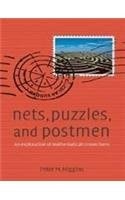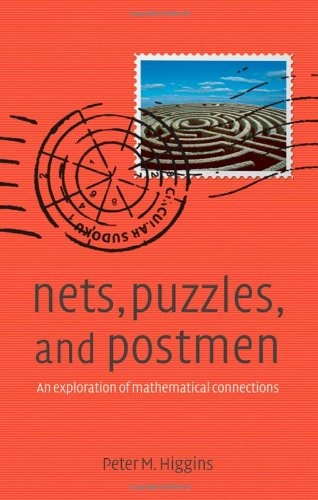
Nets, Puzzles and Postmen: An Exploration of Mathematical Connections
0
0
As an Amazon Associate and affiliate partner, Menrva Books earns from qualifying purchases. Learn more
Author Description
What do road and railway systems, mingling at parties, mazes, family trees, and the internet all have in common? All are networks--either people or places or things that relate and connect to one another. In this stimulating book, Peter Higgins shows that these phenomena--and many more--all share the same deep mathematical structure.The mathematics of networks form the basis of many fascinating puzzles and problems, from tic-tac-toe to circular sudoku. Higgins reveals that understanding networks can give us remarkable new insights into many of these puzzles as well as into a wide array of real-world phenomena. Higgins offers new perspectives on such familiar mathematical quandaries as the four-color map and the bridges of Konisberg. He poses the tantalizing question Can you walk through all the doors of the house just once? He also sheds light on the Postman Problem, a puzzle first posed by a Chinese mathematician: what is the most efficient way of delivering your letters, so you get back to your starting point without having traversed any street twice. And he explores the Harem Problem--a generalization of the Marriage Problem--in which we work out how to satisfy all members of a set of men who have expressed a wish for a harem of wives.Only relatively recently have mathematicians begun to explore networks and connections, and their importance has taken everyone by surprise. Nets, Puzzles, and Postmen takes readers on a dazzling tour of this new field, in a book that will delight math buffs everywhere.
Menrva's Summary
THE THESIS
This book investigates the underlying mathematical structures of networks and how they govern both abstract puzzles and complex real-world systems. Peter M. Higgins, a professor of mathematics, utilizes his expertise to demonstrate that seemingly disparate phenomena—from social interactions and transportation grids to the internet—share a common foundation in graph theory. By bridging the gap between recreational puzzles and formal mathematical inquiry, the author provides a framework for understanding connectivity and efficiency in various systems.
THE SCOPE MAP
What You Will Find
- An introduction to graph theory and the mathematics of networks.
- Analysis of classical mathematical problems including the Four Color Theorem and the Bridges of Konigsberg.
- Practical applications of network theory to the Postman Problem and the Marriage Problem.
- Exploration of how network structures appear in social dynamics, family trees, and infrastructure.
THE AUTHORITY PERSPECTIVE
Experts and math enthusiasts frequently cite this work as an accessible entry point into the study of graph theory for non-specialists. Readers often note that the prose successfully balances historical context with clear explanations of complex logical concepts.
Page Count:
247
Publication Date:
2008-02-20
Publisher:
Oxford University Press
ISBN-10:
0199218420
ISBN-13:
9780199218424
Science
Popular Science
Graph Theory
Mathematics
Logic
Puzzles
Community Tags
Similar Books