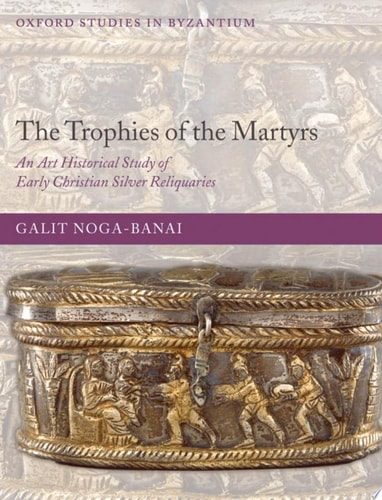
The Trophies of the Martyrs: An Art Historical Study of Early Christian Silver Reliquaries
0
0
As an Amazon Associate and affiliate partner, Menrva Books earns from qualifying purchases. Learn more
Author Description
In this pioneering study, the first of its kind, Galit Noga-Banai analyses silver reliquaries decorated with Christian figurative themes. She offers a clearer and more detailed picture of the beginnings of the cult of relics, which were an essential asset to the Church in its establishment of pilgrimage centres and local hagiographic heritage sites, first in Italy and later in other places around Europe and North Africa. At the same time, Noga-Banai highlights the identity of the objects as portable art, treating the reliquaries as visual historical testimonies. The book is illustrated with nearly 100 finely reproduced drawings and photographs.
Menrva's Summary
THE THESIS
This study investigates the function and cultural significance of early Christian silver reliquaries as both religious artifacts and portable works of art. Galit Noga-Banai, an expert in Byzantine art and material culture, utilizes a rigorous art-historical framework to examine how these objects facilitated the growth of the cult of relics. By analyzing the iconography and physical construction of these silver vessels, the author demonstrates how they served as critical tools for the Church in establishing pilgrimage sites and defining local hagiographic traditions across Italy, Europe, and North Africa.
THE SCOPE MAP
What You Will Find
- Analysis of silver reliquaries featuring Christian figurative themes.
- Examination of the role of portable art in the development of early pilgrimage centers.
- Integration of nearly 100 high-quality drawings and photographs for visual evidence.
- Historical mapping of the spread of relic veneration from Italy to broader European and North African territories.
THE AUTHORITY PERSPECTIVE
Scholars and historians recognize this work as a foundational text for understanding the intersection of material culture and early Christian practice. Readers frequently note the academic density of the prose and the precision of the visual analysis provided by the author.
Page Count:
300
Publication Date:
2008-07-15
Publisher:
Oxford University Press
ISBN-10:
0199217742
ISBN-13:
9780199217748
English
art byzantine
Art History
English & College Success
Christianity
Silverwork
Archaeology
Byzantine History
Christian Art
Community Tags
Similar Books