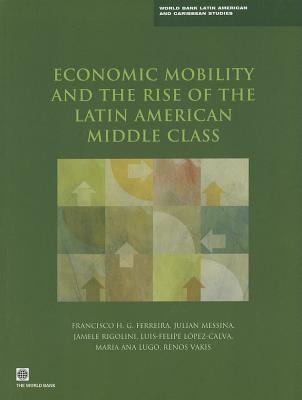
Economic Mobility And The Rise Of The Latin American Middle Class
0
0
As an Amazon Associate and affiliate partner, Menrva Books earns from qualifying purchases. Learn more
Author Description
After decades of stagnation, the size of Latin America's middle class recently expanded to the point where, for the first time ever, the number of people in poverty is equal to the size of the middle class. This volume investigates the nature, determinants and possible consequences of this remarkable process of social transformation. We propose an original definition of the middle class, tailor-made for Latin America, centered on the concept of economic security and thus a low probability of falling into poverty. Given our definition of the middle class, there are four, not three, classes in Latin America. Sandwiched between the poor and the middle class there lies a large group of people who appear to make ends meet well enough, but do not enjoy the economic security that would be required for membership of the middle class. We call this group the 'vulnerable'. In an almost mechanical sense, these transformations in Latin America reflect both economic growth and declining inequality in over the period. We adopt a measure of mobility that decomposes the 'gainers' and 'losers' in society by social class of each household. The continent has experienced a large amount of churning over the last 15 years, at least 43% of all Latin Americans changed social classes between the mid 1990s and the end of the 2000s. Despite the upward mobility trend, intergenerational mobility, a better proxy for inequality of opportunity, remains stagnant. Educational achievement and attainment remain to be strongly dependent upon parental education levels. Despite the recent growth in pro-poor programs, the middle class has benefited disproportionally from social security transfers and are increasingly opting out from government services. Central to the region's prospects of continued progress will be its ability to harness the new middle class into a new, more inclusive social contract, where the better-off pay their fair share of taxes, and demand improved public services.
Menrva's Summary
THE THESIS
This book investigates the recent expansion of Latin America's middle class and its implications for social and economic structures. Francisco H. G. Ferreira, drawing on extensive data, proposes a new definition of the middle class centered on economic security, identifying a distinct 'vulnerable' class between the poor and the middle class. The analysis reveals significant social mobility over the past 15 years, with a substantial portion of the population changing social classes, yet intergenerational mobility and educational attainment remain tied to parental background. The book argues that harnessing this new middle class into a more inclusive social contract, involving fair taxation and improved public services, is crucial for the region's continued progress.
THE SCOPE MAP
- An original definition of the middle class tailored for Latin America, emphasizing economic security.
- Identification of a distinct 'vulnerable' class situated between the poor and the middle class.
- Analysis of social mobility trends, including the extent of class changes between the mid-1990s and late 2000s.
- Examination of intergenerational mobility and its dependence on parental education levels.
- Discussion of the middle class's disproportionate benefit from social security transfers and their increasing opt-out from public services.
- Proposals for a new, inclusive social contract involving taxation and public service demand.
THE AUTHORITY PERSPECTIVE
The book is regarded as a significant contribution to understanding socioeconomic dynamics in Latin America. Its novel definition of the middle class and detailed analysis of social mobility provide a fresh perspective on the region's development. The work highlights persistent challenges in intergenerational mobility and educational equity, even amidst recent economic gains. Ultimately, it calls for a more inclusive social contract to ensure sustained progress.
Page Count:
182
Publication Date:
2012-01-01
ISBN-10:
082139634X
ISBN-13:
9780821396346
Economics
History
Non-Fiction
Poverty
Middle class
Social Science
Latin America
Community Tags
Similar Books