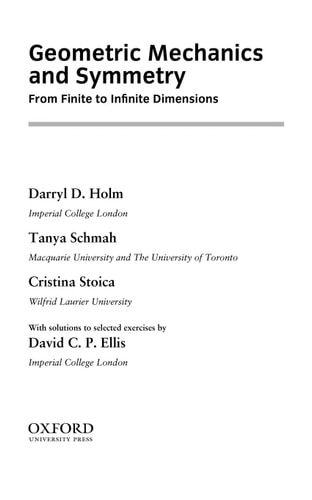
Geometric Mechanics and Symmetry: From Finite to Infinite Dimensions
0
0
As an Amazon Associate and affiliate partner, Menrva Books earns from qualifying purchases. Learn more
Author Description
Classical mechanics, one of the oldest branches of science, has undergone a long evolution, developing hand in hand with many areas of mathematics, including calculus, differential geometry, and the theory of Lie groups and Lie algebras. The modern formulations of Lagrangian and Hamiltonian mechanics, in the coordinate-free language of differential geometry, are elegant and general. They provide a unifying framework for many seemingly disparate physical systems, such as n-particle systems, rigid bodies, fluids and other continua, and electromagnetic and quantum systems.Geometric Mechanics and Symmetry is a friendly and fast-paced introduction to the geometric approach to classical mechanics, suitable for a one- or two- semester course for beginning graduate students or advanced undergraduates. It fills a gap between traditional classical mechanics texts and advanced modern mathematical treatments of the subject. After a summary of the necessary elements of calculus on smooth manifolds and basic Lie group theory, the main body of the text considers how symmetry reduction of Hamilton's principle allows one to derive and analyze the Euler-Poincaré equations for dynamics on Lie groups.Additional topics deal with rigid and pseudo-rigid bodies, the heavy top, shallow water waves, geophysical fluid dynamics and computational anatomy. The text ends with a discussion of the semidirect-product Euler-Poincaré reduction theorem for ideal fluid dynamics.A variety of examples and figures illustrate the material, while the many exercises, both solved and unsolved, make the book a valuable class text.
Menrva's Summary
THE THESIS
This text investigates the application of differential geometry and Lie group theory to provide a unified, coordinate-free framework for classical mechanics. The authors, Cristina Stoica, Darryl D. Holm, and Tanya Schmah, synthesize advanced mathematical concepts with physical dynamics to bridge the gap between introductory undergraduate mechanics and high-level research literature. By utilizing symmetry reduction of Hamilton's principle, the book establishes a rigorous methodology for analyzing complex systems ranging from rigid bodies to fluid dynamics.
THE SCOPE MAP
What You Will Find
- Calculus on smooth manifolds and foundational Lie group theory.
- Symmetry reduction techniques applied to Hamilton's principle.
- Derivation and analysis of Euler-Poincaré equations for dynamics on Lie groups.
- Applications to geophysical fluid dynamics, computational anatomy, and shallow water waves.
- A collection of solved and unsolved exercises for pedagogical reinforcement.
THE AUTHORITY PERSPECTIVE
Experts identify this work as a bridge between traditional mechanics curricula and modern geometric research. Readers frequently note the technical density of the prose, which requires a solid background in multivariable calculus and linear algebra to fully grasp the presented material.
Page Count:
460
Publication Date:
2009-10-04
Publisher:
Oxford University Press
ISBN-10:
0199212910
ISBN-13:
9780199212910
Mathematical Physics
Applied Mathematics
Symmetry
Differential Geometry
Mathematics
Physics
Classical Mechanics
Community Tags
Similar Books