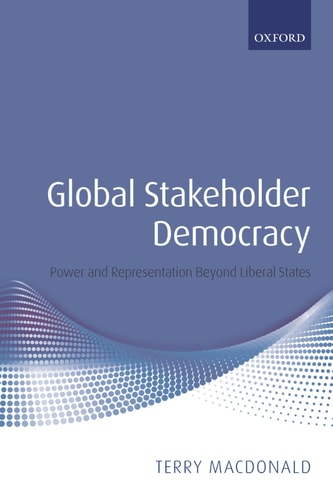
Global Stakeholder Democracy: Power and Representation Beyond Liberal States
0
0
As an Amazon Associate and affiliate partner, Menrva Books earns from qualifying purchases. Learn more
Author Description
A pressing question at the forefront of current global political debates is: how can we salvage the democratic project in the context of 'globalization'? In recent years political activists have mounted high-profile campaigns for the democratization of powerful international institutions such as the World Bank and IMF, and for greater 'corporate accountability'. In turn, many of the NGOs linked to these campaigns have themselves faced demands for greater democratic legitimacy. Global Stakeholder Democracy responds to these challenges by outlining an innovative theoretical and institutional framework for democratizing the many state and non-state actors wielding public power in contemporary global politics. In doing so, the book lays out a promising new agenda for global democratic reform. Its analysis begins with the recognition that we cannot simply recreate traditional constitutional and electoral institutions of democratic states on a global scale, through the construction of a democratic 'super-state'. Rather, we must develop new kinds of democratic institutions capable of dealing with the realities of global pluralism, and democratizing powerful non-state actors as well as states.Through reflecting on the democratic dilemmas surrounding the political power of global NGOs, the book mounts a powerful challenge to the state-centric theoretical assumptions that have underpinned the established democratic theories of both 'cosmopolitan' and 'communitarian' liberals. In particular, it challenges the widespread assumption that 'sovereign' power, 'bounded' (national or global) societies, and 'electoral' processes are essential institutional foundations of a democratic system. The book then re-thinks the democratic project from its conceptual foundations, posing the questions: What needs to be controlled? Who ought to control it? How could they do so? In answering these questions, the book develops a novel theoretical model of representative democracy that is focused on plural (state and non-state) actors rather than on unitary state structures. It elaborates a democratic framework based on the new theoretical concepts of 'public power', 'stakeholder communities' and 'non-electoral representation', and illustrates the practical implications of these proposals for projects of global institutional reform.
Menrva's Summary
THE THESIS
How can the democratic project be salvaged and effectively applied to the diverse array of state and non-state actors operating within the modern globalized landscape? Terry Macdonald, a scholar of political theory, examines the limitations of traditional state-centric democratic models in an era of transnational power. By analyzing the influence of international institutions, corporations, and NGOs, the author argues for a shift away from electoral, nation-state-based frameworks toward a more inclusive model of representative democracy that accounts for global pluralism.
THE SCOPE MAP
What You Will Find
- A critique of traditional 'cosmopolitan' and 'communitarian' liberal democratic theories.
- A theoretical framework for democratizing non-state actors such as international NGOs and global institutions.
- An analysis of the relationship between sovereign power and global political accountability.
- A proposed model of representative democracy designed to function beyond the constraints of the nation-state.
THE AUTHORITY PERSPECTIVE
Experts in international relations and political theory recognize this work as a significant contribution to the discourse on global governance and institutional reform. Readers frequently note the academic density of the prose, which is intended for scholars and students engaged in advanced political research.
Page Count:
280
Publication Date:
2008-10-15
Publisher:
Oxford University Press
ISBN-10:
0199235007
ISBN-13:
9780199235001
Globalization
Representative government and representation
Power Social sciences
Democracy
Political Theory
International relations
Community Tags
Similar Books







Reader Comments
Share Your Thoughts
No comments yet. Be the first to share your thoughts!