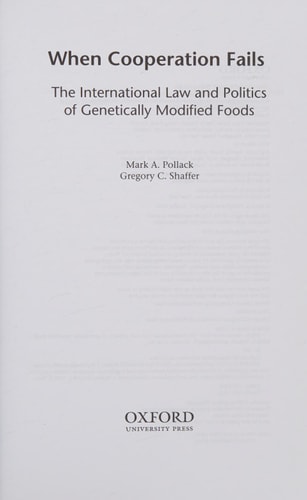
When Cooperation Fails: The International Law and Politics of Genetically Modified Foods
0
0
As an Amazon Associate and affiliate partner, Menrva Books earns from qualifying purchases. Learn more
Author Description
The transatlantic dispute over genetically modified organisms (GMOs) has brought into conflict the United States and the European Union, two long-time allies and economically interdependent democracies with a long record of successful cooperation. Yet the dispute - pitting a largely acceptant US against an EU deeply suspicious of GMOs - has developed into one of the most bitter and intractable transatlantic and global conflicts, resisting efforts at negotiated resolution and resulting in a bitterly contested legal battle before the World Trade Organization.Professors Pollack and Shaffer investigate the obstacles to reconciling regulatory differences among nations through international cooperation, through the lens of the GMO dispute. The book addresses the dynamic interactions of domestic law and politics, transnational networks, international regimes, and global markets, through a theoretically grounded and empirically comprehensive analysis of the governance of GM foods and crops. They demonstrate that the deeply politicized, entrenched and path-dependent nature of the regulation of GMOs in the US and the EU has fundamentally shaped negotiations and decision-making at the international level, limiting the prospects for deliberation and providing incentives for both sides to engage in hard bargaining and to "shop" for favorable international forums. They then assess the impacts, and the limits, of international pressures on domestic US and European law, politics and business practice, which have remained strikingly resistant to change.International cooperation in areas like GMO regulation, the authors conclude, must overcome multiple obstacles, legal and political, domestic and international. Any effective response to this persistent dispute, they argue, must recognize both the obstacles to successful cooperation, and the options that remain for each side when cooperation fails.
Menrva's Summary
THE THESIS
This book investigates why international cooperation fails to resolve regulatory conflicts between nations, specifically focusing on the transatlantic dispute over genetically modified organisms. Professors Gregory C. Shaffer and Mark A. Pollack utilize their expertise in international law and political science to analyze how domestic political entrenchment and path-dependent regulatory frameworks prevent consensus. By examining the interactions between the United States and the European Union, the authors argue that deep-seated domestic resistance often overrides international pressure, leading to protracted legal battles rather than collaborative solutions.
THE SCOPE MAP
What You Will Find
- A detailed analysis of the World Trade Organization legal proceedings regarding GMO imports.
- A theoretical framework for understanding the intersection of domestic law, transnational networks, and global markets.
- Empirical case studies comparing US and EU regulatory approaches to biotechnology.
- An assessment of the limitations of international regimes in forcing domestic policy changes.
THE AUTHORITY PERSPECTIVE
Experts recognize this work as a foundational text for understanding the complexities of international trade disputes and regulatory governance. Readers frequently note the academic density of the prose, which provides a rigorous examination of why cooperation often remains elusive in highly politicized sectors.
Page Count:
456
Publication Date:
2009-07-15
Publisher:
Oxford University Press
ISBN-10:
019923728X
ISBN-13:
9780199237289
Public Policy
International Law
Globalization
Agriculture
Community Tags
Similar Books