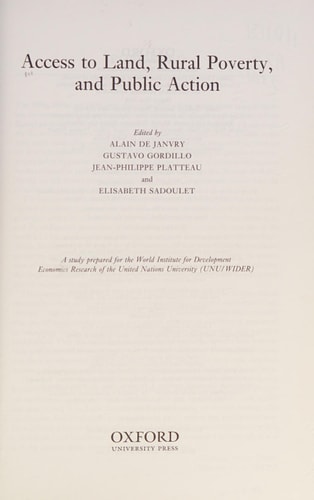
Access to Land, Rural Poverty, and Public Action
0
0
As an Amazon Associate and affiliate partner, Menrva Books earns from qualifying purchases. Learn more
Author Description
Redesigning access to land to increase efficiency and reduce poverty is back on the policy agenda. This book broadens the analysis of alternative options beyond state-led redistributions to consider channels of access such as inheritance and inter-vivos transfers, intra-household and intra-community land allocations, community titling of open access resources, the break up of common property resources and the individualization of rights, decollectivization, land markets, and land rental contracts. Each of these channels of access to land is analyzed, and recommendations made to enhance their effectiveness for poverty reduction.
Menrva's Summary
THE THESIS
This book investigates how diverse mechanisms of land access can be optimized to improve economic efficiency and alleviate rural poverty. The authors, a team of distinguished development economists, synthesize global research to move beyond traditional state-led land redistribution models. They propose a comprehensive framework that evaluates how various institutional channels—ranging from inheritance and rental markets to community-based titling—function within different socio-economic contexts to influence rural livelihoods.
THE SCOPE MAP
What You Will Find
- Analysis of alternative land access channels including inheritance, inter-vivos transfers, and rental contracts.
- Evaluation of community-based resource management and the individualization of property rights.
- Comparative study of decollectivization processes and their impact on rural equity.
- Policy recommendations for enhancing the effectiveness of land-based poverty reduction strategies.
THE AUTHORITY PERSPECTIVE
Experts recognize this volume as a foundational text for understanding the complexities of land tenure in developing economies. Scholars frequently cite the work for its rigorous analytical approach to institutional economics and its practical implications for policy design.
Page Count:
472
Publication Date:
2001-06-07
Publisher:
Oxford University Press
ISBN-10:
0199242178
ISBN-13:
9780199242177
Economics
Public Policy
Agriculture
Land tenure
Rural poor
Land Reform
Land Use
Community Tags
Similar Books