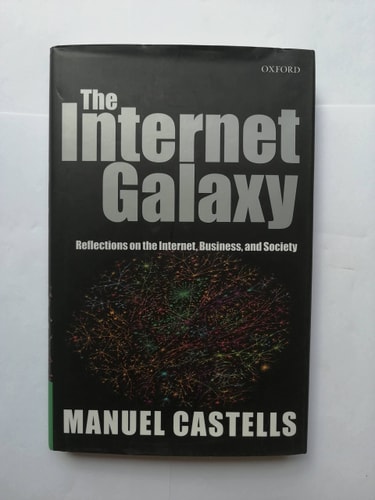
The Internet Galaxy: Reflections on the Internet, Business, and Society
0
0
As an Amazon Associate and affiliate partner, Menrva Books earns from qualifying purchases. Learn more
Author Description
Manuel Castells is one of the world's leading thinkers on the new information age, hailed by The Economist as "the first significant philosopher of cyberspace," and by Christian Science Monitor as "a pioneer who has hacked out a logical, well-documented, and coherent picture of early 21st century civilization, even as it rockets forward largely in a blur." Now, in The Internet Galaxy, this brilliantly insightful writer speculates on how the Internet will change our lives.Castells believes that we are "entering, full speed, the Internet Galaxy, in the midst of informed bewilderment." His aim in this exciting and profound work is to help us to understand how the Internet came into being, and how it is affecting every area of human life--from work, politics, planning and development, media, and privacy, to our social interaction and life in the home. We are at ground zero of the new network society. In this book, its major commentator reveals the Internet's huge capacity to liberate, but also its ability to marginalize and exclude those who do not have access to it. Castells provides no glib solutions, but asks us all to take responsibility for the future of this new information age.The Internet is becoming the essential communication and information medium in our society, and stands alongside electricity and the printing press as one of the greatest innovations of all time. The Internet Galaxy offers an illuminating look at how this new technology will influence business, the economy, and our daily lives.
Menrva's Summary
THE THESIS
This book investigates how the emergence of the Internet functions as a transformative force reshaping the fundamental structures of business, politics, and social interaction in the 21st century. Manuel Castells, a renowned sociologist and expert on the information age, synthesizes extensive research on network society to argue that the Internet is a foundational innovation comparable to electricity or the printing press. He examines the dual capacity of this technology to both empower global connectivity and create new forms of social exclusion. The work serves as a critical framework for understanding the rapid transition into a digital-first civilization.
THE SCOPE MAP
What You Will Find
- Analysis of the historical origins and development of the Internet as a social and technical system.
- Examination of the impact of digital networks on corporate business models and global economic structures.
- Discussion of the intersection between digital privacy, media consumption, and domestic life.
- Evaluation of the political implications of the network society, including issues of access and marginalization.
THE AUTHORITY PERSPECTIVE
Experts and academics recognize this work as a foundational text for understanding the early sociological impacts of the digital revolution. Readers frequently note the analytical depth of the prose, which balances technical observation with broad philosophical inquiry into the future of human society.
Page Count:
304
Publication Date:
2001-12-13
Publisher:
Oxford University Press
ISBN-10:
0199241538
ISBN-13:
9780199241538
Business
Technology
Information society
Sociology
Internet
Communication
Community Tags
Similar Books