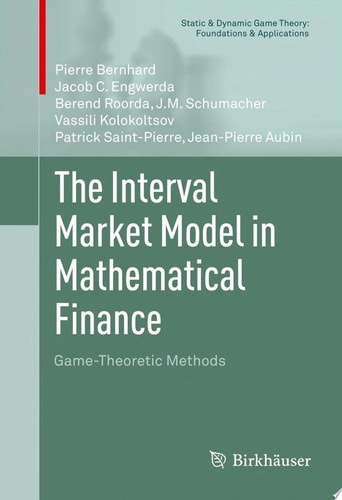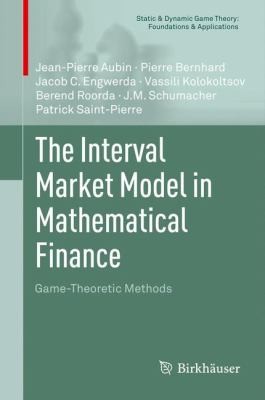
The Interval Market Model in Mathematical Finance: Game-Theoretic Methods
0
0
As an Amazon Associate and affiliate partner, Menrva Books earns from qualifying purchases. Learn more
Author Description
Toward the late 1990s, several research groups independently began developing new, related theories in mathematical finance. These theories did away with the standard stochastic geometric diffusion “Samuelson” market model (also known as the Black-Scholes model because it is used in that most famous theory), instead opting for models that allowed minimax approaches to complement or replace stochastic methods. Among the most fruitful models were those utilizing game-theoretic tools and the so-called interval market model. Over time, these models have slowly but steadily gained influence in the financial community, providing a useful alternative to classical methods. A self-contained monograph, The Interval Market Model in Mathematical Finance: Game-Theoretic Methods assembles some of the most important results, old and new, in this area of research. Written by seven of the most prominent pioneers of the interval market model and game-theoretic finance, the work provides a detailed account of several closely related modeling techniques for an array of problems in mathematical economics. The book is divided into five parts, which successively address topics including: · probability-free Black-Scholes theory; · fair-price interval of an option; · representation formulas and fast algorithms for option pricing; · rainbow options; · tychastic approach of mathematical finance based upon viability theory. This book provides a welcome addition to the literature, complementing myriad titles on the market that take a classical approach to mathematical finance. It is a worthwhile resource for researchers in applied mathematics and quantitative finance, and has also been written in a manner accessible to financially-inclined readers with a limited technical background.
Menrva's Summary
THE THESIS
This book investigates the development and application of interval market models and game-theoretic methods as alternatives to traditional stochastic models in mathematical finance. The work, authored by pioneers in the field, assembles key results, both established and novel, in this area. It details closely related modeling techniques applicable to various problems in mathematical economics, offering a contrast to classical approaches and serving as a valuable resource for researchers and financially-inclined readers with a foundational technical background.
THE SCOPE MAP
- Probability-free Black-Scholes theory
- Fair-price interval of an option
- Representation formulas and fast algorithms for option pricing
- Rainbow options
- Tychastic approach of mathematical finance based upon viability theory
THE AUTHORITY PERSPECTIVE
The book is presented as a valuable addition to the literature, offering a complementary perspective to classical mathematical finance texts. It is specifically recommended for researchers in applied mathematics and quantitative finance. The authors have also structured the content to be accessible to readers with a limited technical background but an interest in finance.
Page Count:
364
Publication Date:
2012-01-01
ISBN-10:
0817683879
ISBN-13:
9780817683870
Economics
Business
Non-Fiction
Science
Game theory
Mathematical Finance
Community Tags
Similar Books