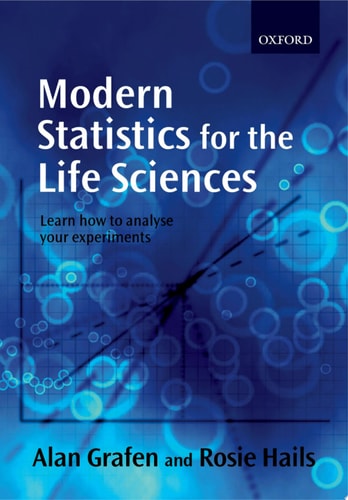
Modern Statistics for the Life Sciences
0
0
As an Amazon Associate and affiliate partner, Menrva Books earns from qualifying purchases. Learn more
Author Description
Model formulae represent a powerful methodology for describing, discussing, understanding, and performing the component of statistical tests known as linear statistics. It was developed for professional statisticians in the 1960s and has become increasingly available as the use of computers has grown and software has advanced. Modern Statistics for Life Scientists puts this methodology firmly within the grasp of undergraduates for the first time. The authors assume a basic knowledge of statistics--up to and including one and two sample t-tests and their non-parametric equivalents. They provide the conceptual framework needed to understand what the method does--but without mathematical proofs--and introduce the ideas in a simple and steady progression with worked examples and exercises at every stage.This innovative text offers students a single conceptual framework for a wide range of tests-including t-tests, oneway and multiway analysis of variance, linear and polynomial regressions, and analysis of covariance-that are usually introduced separately. More importantly, it gives students a language in which they can frame questions and communicate with the computers that perform the analyses. A companion website, www.oup.com/grafenhails, provides a wealth of worked exercises in the three statistical languages; Minitab, SAS, and SPSS. Appropriate for use in statistics courses at undergraduate and graduate levels, Modern Statistics for the Life Sciences is also a helpful resource for students in non-mathematics-based disciplines using statistics, such as geography, psychology, epidemiology, and ecology.
Menrva's Summary
THE THESIS
This text investigates how model formulae can serve as a unified conceptual framework for performing linear statistical tests in the life sciences. The authors, Alan Grafen and Rosie Hails, address the gap between professional statistical methodology and undergraduate comprehension by stripping away complex mathematical proofs. They present a steady, logical progression of statistical concepts, enabling students to communicate effectively with analytical software while applying these methods to diverse biological and ecological datasets.
THE SCOPE MAP
What You Will Find
- Comprehensive coverage of linear statistics including t-tests, analysis of variance, and linear regression.
- A unified methodology for framing statistical questions across multiple disciplines.
- Practical application through worked examples and exercises designed for undergraduate and graduate students.
- Integration with statistical software languages including Minitab, SAS, and SPSS.
THE AUTHORITY PERSPECTIVE
Experts and educators recognize this text as a foundational resource for students who require a practical, non-mathematical approach to complex statistical modeling. Readers frequently note the clarity of the prose, which successfully bridges the gap between theoretical statistics and applied research in fields like ecology and psychology.
Page Count:
368
Publication Date:
2002-05-09
Publisher:
Oxford University Press
ISBN-10:
0199252319
ISBN-13:
9780199252312
Science
Mathematics
Biology
Reference
Education
Statistics
Life sciences
Community Tags
Similar Books