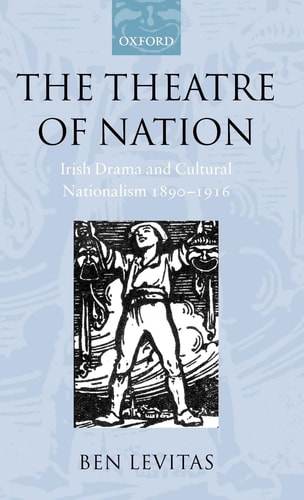
The Theatre of Nation: Irish Drama and Cultural Nationalism 1890-1916
0
0
As an Amazon Associate and affiliate partner, Menrva Books earns from qualifying purchases. Learn more
Author Description
What role did the theatre of the Irish literary revival play in the politics of identity so avidly debated in pre-revolutionary Ireland? Conversely, how far did that debate influence the development of the theatre? Ben Levitas pursues such vexed questions through a panoramic study of Irish drama and the nationalist debate 1890-1916. He follow the unfolding drama of that relationship and, in giving equal weight to the protagonists inside and outside the theatre movement, provides fresh insight into the dynamics of Irish cultural politics. Extending the range of the drama beyond the canonical works considered by most critics, and beyond Dublin to the influence of Cork and Ulster, The Theatre of Nation tackles many neglected and forgotten texts which through the circumstances of their reception are given new force.In this way, the lesser lights of the Irish revival illuminate unfamiliar aspects of familiar writers such as W. B. Yeats, Lady Gregory, and J. M. Synge, while discussions and disputes both private and public are engaged to comment upon the implications of the theatre movement for nationalist ambitions. The evolution of cultural and political nationalist groups such as Irish Ireland, the Gaelic League and Sinn Fein is similarly examined to reveal a shifting terrain of nationalist opinion disturbed by issued of class, gender, and generation. An integrated investigation of the politics of drama and its influence in Ireland, The Theatre of Nation concludes that Ireland's theatre had a pivotal role to play in the controversies of its time and in the coming revolution.
Menrva's Summary
THE THESIS
This work investigates the reciprocal influence between the Irish literary revival and the development of nationalist political identity in Ireland between 1890 and 1916. Ben Levitas, an academic researcher, utilizes a wide array of primary sources, including private correspondence, public debates, and neglected dramatic texts, to argue that the theatre was not merely a reflection of Irish politics but a primary site for their construction. By examining the interplay between playwrights and political organizations, the author demonstrates how the stage served as a catalyst for the ideological shifts that preceded the Irish revolution.
THE SCOPE MAP
What You Will Find
- A comprehensive analysis of the Irish literary revival spanning from 1890 to 1916.
- Examination of the influence of regional centers such as Cork and Ulster alongside the Dublin-centric narrative.
- Integration of political history from organizations like the Gaelic League and Sinn Fein with theatrical history.
- Critical reassessment of canonical figures such as W. B. Yeats and J. M. Synge alongside lesser-known playwrights.
THE AUTHORITY PERSPECTIVE
Scholars and historians frequently cite this text as a foundational study for understanding the intersection of Irish cultural production and political radicalization. Readers often note the academic density of the prose, which provides a rigorous, evidence-based framework for analyzing the complexities of pre-revolutionary Irish identity.
Page Count:
280
Publication Date:
2003-02-13
Publisher:
Clarendon Press
ISBN-10:
0199253439
ISBN-13:
9780199253432
Drama
History
Theater And Society
Nationalism ireland
Literary Criticism
Theater ireland
Irish literature
Community Tags
Similar Books