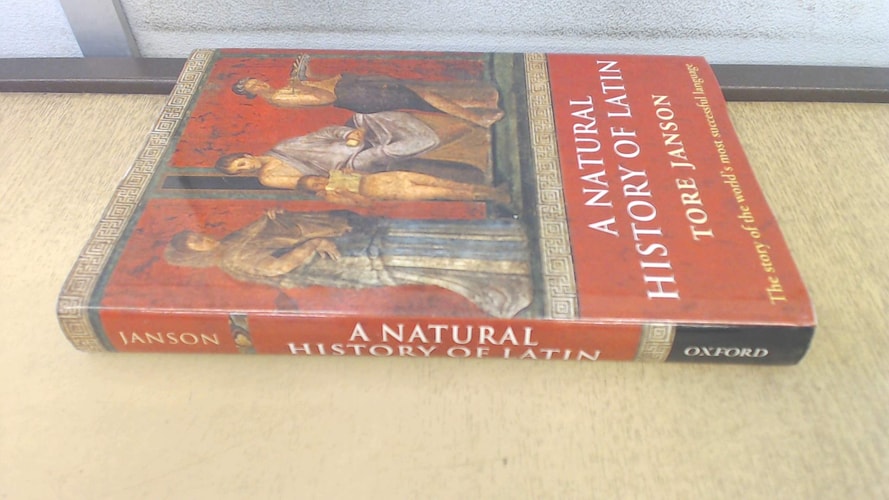
A Natural History of Latin
0
0
As an Amazon Associate and affiliate partner, Menrva Books earns from qualifying purchases. Learn more
Author Description
No known language, including English, has achieved the success and longevity of Latin. French, Spanish, Italian, and Romanian are among its direct descendants, and countless Latin words and phrases comprise the cornerstone of English itself. A Natural History or Latin tells its history from its origins over 2500 years ago to the present. Brilliantly conceived, popularizing but authoritative, and written with the fluency and light touch that have made Tore Janson's Speak so attractive to tens of thousands of readers, it is a masterpiece of adroit synthesis.The book commences with a description of the origins, emergence, and dominance of Latin over the Classical period. Then follows an account of its survival through the Middle Ages into modern times, with emphasis on its evolution throughout the history, culture, and religious practices of Medieval Europe. By judicious quotation of Latin words, phrases, and texts the author illustrates how the written and spoken language changed, region by region over time; how it met resistance from native languages; and how therefore some entire languages disappeared. Janson offers a vivid demonstration of the value of Latin as a means of access to a vibrant past and a persuasive argument for its continued worth. A concise and easy-to-understand introduction to Latin grammar and a list of the most frequent Latin words, including 500 idioms and phrases still in common use, complement the work.
Menrva's Summary
THE THESIS
This work investigates the historical trajectory of Latin, examining how a regional dialect evolved into a foundational linguistic force that shaped Western civilization and modern Romance languages. The authors, including linguist Tore Janson, utilize a synthesis of historical data, cultural analysis, and linguistic evolution to track the language from its ancient origins through the Middle Ages and into contemporary usage. The text argues that Latin remains a vital key to understanding the development of European culture, religion, and the structure of modern English.
THE SCOPE MAP
What You Will Find
- A chronological history of Latin from its emergence in the Classical period to its modern influence.
- An analysis of the evolution of Latin into various Romance languages including French, Italian, and Spanish.
- A concise introduction to Latin grammar and syntax for the general reader.
- A curated list of 500 common Latin idioms and phrases still utilized in modern discourse.
THE AUTHORITY PERSPECTIVE
Experts and readers frequently highlight this text as an accessible entry point for those interested in historical linguistics. The prose is noted for its clarity and ability to distill complex philological shifts into a narrative that remains engaging for non-specialist audiences.
Page Count:
320
Publication Date:
2005-01-06
Publisher:
Oxford University Press
ISBN-10:
0199263094
ISBN-13:
9780199263097
History
Non-Fiction
Language
Words Language & Grammar
Foreign Study
Linguistics
Reference
Community Tags
Similar Books