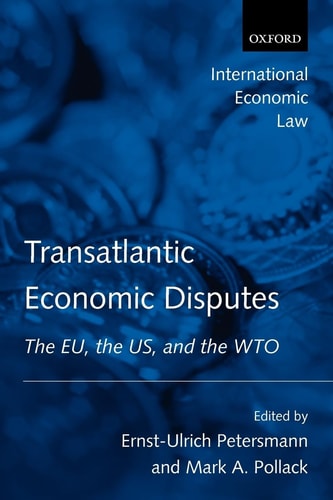
Transatlantic Economic Disputes: The EU, the US and the WTO
0
0
As an Amazon Associate and affiliate partner, Menrva Books earns from qualifying purchases. Learn more
Author Description
Recent transatlantic relations have been plagued by a seemingly endless series of disputes over trade and other economic and political interests. Some of these disputes have been amongst the most prominent of the WTO era: the Bananas Case, the Beef Hormones Case and over the application of the Helms-Burton Act. This book analyzes the source of transatlantic disputes, the means employed to prevent and settle such disputes both bilaterally and through the dispute settlement mechanism of the of the WTO, and to identify promising areas for reform.This book begins with a survey of transatlantic governance and dispute settlement problems. Part II analyzes 14 case-studies of transatlantic economic and regulatory disputes written by leading EU and US experts. The analytical papers in Part III examine the disputes in the broader context of legal, economic and political theories of dispute prevention and dispute settlement. Part IV offers policy recommendations from EU and US policy-makers and academics. Most of the more than 20 contributors conclude that joint EU-US leadership in multilateral institutions (e.g. for trade liberalization, dispute prevention and dispute settlement in the WTO) offers advantages over bilateral approaches. By contrast, a potential transatlantic free-trade association (TAFTA) remains a second-best approach which might not prevent many of the transatlantic disputes over internal trade-related domestic policies. Transatlantic initiatives e.g. forL regulatory cooperation and citizen-oriented institutional reforms can, however, serve as precedents for multilateral reforms (e.g. of WTO rules).
Menrva's Summary
THE THESIS
This book investigates the structural causes of economic and regulatory friction between the European Union and the United States within the framework of the World Trade Organization. The authors, Ernst Ulrich Petersmann and Mark A. Pollack, curate a collection of expert analyses that evaluate the efficacy of bilateral versus multilateral dispute settlement mechanisms. By synthesizing legal theory with political economy, the text argues that joint leadership within global institutions provides a more stable resolution path than isolated bilateral agreements.
THE SCOPE MAP
What You Will Find
- Detailed examination of 14 specific case studies including the Bananas and Beef Hormones disputes.
- Comparative analysis of bilateral dispute resolution versus the WTO dispute settlement mechanism.
- Policy recommendations derived from a diverse group of EU and US academics and government officials.
- Theoretical frameworks addressing the intersection of domestic trade policies and international regulatory cooperation.
THE AUTHORITY PERSPECTIVE
Experts recognize this volume as a comprehensive resource for understanding the complexities of transatlantic trade governance. Readers frequently note the academic density of the prose, which serves as a foundational text for students and practitioners of international economic law.
Page Count:
632
Publication Date:
2004-02-12
Publisher:
Oxford University Press
ISBN-10:
0199261733
ISBN-13:
9780199261734
Economics
European Union
International Law
United States
World Trade Organization
Trade Policy
International relations
Community Tags
Similar Books