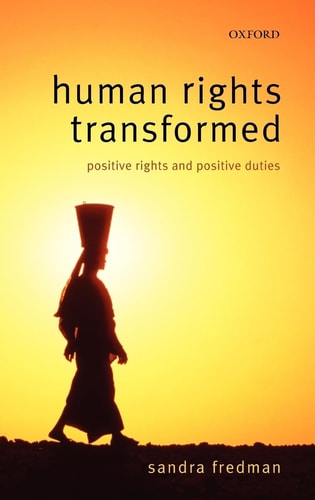
Human Rights Transformed: Positive Rights and Positive Duties
0
0
As an Amazon Associate and affiliate partner, Menrva Books earns from qualifying purchases. Learn more
Author Description
Human rights have traditionally been understood as protecting individual freedom against intrusion by the State. In this book, Sandra Fredman argues that this understanding requires radical revision. Human rights are based on a far richer view of freedom, which goes beyond being let alone, and instead pays attention to individuals' ability to exercise their rights.This view fundamentally shifts the focus of human rights. As well as restraining the State, human rights require the State to act positively to remove barriers and facilitate the exercise of freedom. This in turn breaks down traditional distinctions between civil and political rights and socio-economic rights. Instead, all rights give rise to a range of duties, both negative and positive. However, because positive duties have for so long been regarded as a question of policy or aspiration, little sustained attention has been given to their role in actualising human rights. Drawing on comparative experience from India, South Africa, the European Convention on Human Rights, the European Union, Canada and the UK, this book aims to create a theoretical and applied framework for understanding positive human rights duties.Part I elaborates the values of freedom, equality, and solidarity underpinning a positive approach to human rights duties, and argues that the dichotomy between democracy and human rights is misplaced. Instead, positive human rights duties should strengthen rather than substitute for democracy, particularly in the face of globalization and privatization. Part II considers justiciability, fashioning a democratic role for the courts based on their potential to stimulate deliberative democracy in the wider environment. Part III applies this framework to key positive duties, particularly substantive equality and positive duties to provide, traditionally associated with the Welfare State or socioeconomic rights.
Menrva's Summary
THE THESIS
This book investigates whether the traditional understanding of human rights as mere protections against state intrusion is sufficient, or if it requires a radical revision to include positive state duties. Sandra Fredman, a distinguished legal scholar, challenges the conventional dichotomy between civil/political rights and socio-economic rights. By synthesizing legal theory with comparative analysis, she argues that a robust framework of positive duties is essential for actualizing freedom, equality, and solidarity in an era of globalization and privatization.
THE SCOPE MAP
What You Will Find
- A comparative analysis of human rights frameworks in India, South Africa, Canada, the UK, and the European Union.
- A theoretical model for integrating positive duties into democratic governance and judicial practice.
- An examination of the intersection between substantive equality and the welfare state.
- A critique of the traditional separation between democratic processes and human rights enforcement.
THE AUTHORITY PERSPECTIVE
Legal scholars and practitioners frequently cite this work as a foundational text for understanding the evolution of positive obligations in international human rights law. Experts highlight the author's ability to bridge complex philosophical concepts with practical, applied legal frameworks.
Page Count:
290
Publication Date:
2008-05-15
Publisher:
Oxford University Press
ISBN-10:
019927276X
ISBN-13:
9780199272761
Philosophy
Sociology
Judges
Law
Human rights
Judicial Power
Justice Administration of
Community Tags
Similar Books