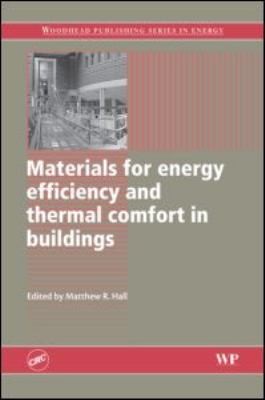
Materials for Energy Efficiency and Thermal Comfort in Buildings
0
0
As an Amazon Associate and affiliate partner, Menrva Books earns from qualifying purchases. Learn more
Author Description
"Almost half of the total energy produced in the developed world is inefficiently used to heat, cool, ventilate and control humidity in buildings, to meet the increasingly high thermal comfort levels demanded by occupants. The utilisation of advanced m̀aterials and passive technologies in buildings would substantially reduce the energy demand and improve the environmental impact and carbon footprint of building stock worldwide." "Materials for energy efficiency and thermal comfort in buildings critically reviews the advanced building materials applicable for improving the built environment. Part I reviews both fundamental building physics and occupant comfort in buildings, from heat and mass transport, hygrothermal behaviour, and ventilation, on to thermal comfort and health and safety requirements." "Part II details the development of advanced materials and sustainable technologies for application in buildings, beginning with a review of lifecycle assessment and environmental profiling of materials. The section moves on to review thermal insulation materials, materials for heat and moisture control, and heat energy storage and passive cooling technologies. Part II concludes with coverage of modern methods of construction, roofing design and technology, and benchmarking of facades for optimised building thermal performance." "Finally, Part III reviews the application of advanced materials, design and technologies in a range of existing and new building types, including domestic, commercial and high-performance buildings, and buildings in hot and tropical climates." "This book will be of particular use to mechanical, electrical and HVAC engineers, architects and low-energy building practitioners worldwide, as well as to academics and researchers in the fields of building physics, civil and building engineering, and materials science."--BOOK JACKET.
Menrva's Summary
THE THESIS
This book investigates how advanced materials and passive technologies can significantly reduce the energy demand of buildings and improve their environmental impact. The text addresses the substantial inefficiency in energy use for heating, cooling, ventilation, and humidity control in developed nations, driven by occupant comfort demands. It aims to provide a comprehensive review of applicable advanced building materials and sustainable technologies, covering fundamental building physics, occupant comfort, lifecycle assessment, insulation, moisture control, heat storage, passive cooling, modern construction methods, roofing, and facade benchmarking. The book is structured into three parts, detailing the physics and comfort requirements, the development of materials and technologies, and their application across various building types and climates.
THE SCOPE MAP
- Fundamental building physics, including heat and mass transport, hygrothermal behavior, and ventilation.
- Occupant comfort, health, and safety requirements in buildings.
- Lifecycle assessment and environmental profiling of building materials.
- Development of advanced materials for thermal insulation and moisture control.
- Heat energy storage and passive cooling technologies.
- Modern methods of construction, roofing design, and facade benchmarking for optimized thermal performance.
- Application of advanced materials and technologies in domestic, commercial, and high-performance buildings.
- Consideration of buildings in hot and tropical climates.
THE AUTHORITY PERSPECTIVE
The book is presented as a critical review of advanced building materials for energy efficiency and thermal comfort, targeting engineers, architects, and researchers. Its comprehensive scope, covering both fundamental principles and practical applications across diverse building types and climates, suggests it serves as a valuable resource for professionals and academics in the field. The detailed breakdown into physics, material development, and application indicates a structured approach to understanding and implementing sustainable building solutions. The emphasis on reducing energy demand and environmental impact positions it within the context of contemporary concerns for sustainable development in the built environment.
Page Count:
734
Publication Date:
2010-01-01
ISBN-10:
1439829705
ISBN-13:
9781439829707
Architecture
Science & Technology
Non-Fiction
Building Science
Community Tags
Similar Books