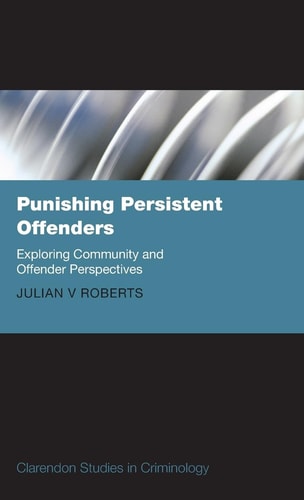
Punishing Persistent Offenders: Exploring Community and Offender Perspectives
0
0
As an Amazon Associate and affiliate partner, Menrva Books earns from qualifying purchases. Learn more
Author Description
Despite very diverse approaches towards punishing crime, all Western jurisdictions punish repeat offenders more harshly (a practice known as the recidivist sentencing premium). For many repeat offenders, their previous convictions have more impact on the penalty they receive than the seriousness of their current crime. Why do we punish recidivists more harshly? Some sentencing theorists argue that offenders should be punished only for the crimes they commit - not for the crimes committed and paid for in the past. From this perspective, punishing repeat offenders more severely amounts to double punishment. Having been punished once for an offence, the recidivist will pay for the crime again every time he re-offends. Is this fair?This volume explores the nature and consequences of the recidivist sentencing premium on both the theoretical and empirical levels. It begins by exploring the justifications for treating repeat offenders more harshly, and then provides examples of the practice from a number of jurisdictions including England and Wales, Canada, and the United States. Particular attention is paid to the views of two important groups: convicted offenders and the general public. If offenders believe that the recidivist sentencing premium is unjustified, they are less likely to accept the legitimacy of the justice system. As for members of the public, it is important to know whether this key element of the sentencing process is consistent with community views.
Menrva's Summary
THE THESIS
This volume investigates the ethical and practical justifications for the recidivist sentencing premium, which mandates harsher penalties for repeat offenders across Western legal jurisdictions. Julian V. Roberts, a prominent scholar in sentencing and criminal justice, utilizes a combination of legal theory and empirical data to analyze whether punishing past behavior alongside current offenses constitutes double jeopardy. The text examines the tension between retributive justice and public policy, questioning the legitimacy of a system that prioritizes prior criminal history over the severity of the current offense.
THE SCOPE MAP
What You Will Find
- Comparative analysis of sentencing practices in England, Wales, Canada, and the United States.
- Theoretical frameworks regarding the justification of recidivist sentencing premiums.
- Empirical data derived from public opinion surveys on sentencing fairness.
- Qualitative insights into how convicted offenders perceive the legitimacy of the justice system.
THE AUTHORITY PERSPECTIVE
Legal scholars and criminologists recognize this work as a critical examination of the intersection between public perception and judicial policy. The text is frequently cited for its balanced approach to the complex moral arguments surrounding repeat offender sentencing.
Page Count:
200
Publication Date:
2008-04-15
Publisher:
Oxford University Press
ISBN-10:
0199283893
ISBN-13:
9780199283897
Sociology
Criminology
Law
Sentencing Policy
Community Tags
Similar Books