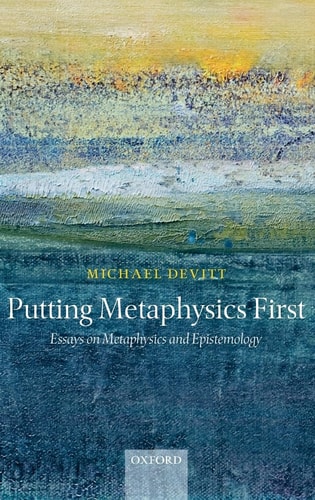
Putting Metaphysics First: Essays on Metaphysics and Epistemology
0
0
As an Amazon Associate and affiliate partner, Menrva Books earns from qualifying purchases. Learn more
Author Description
The metaphysical part of this book is largely concerned with realism issues. Michael Devitt starts with realism about universals, dismissing Plato's notorious 'one over many' problem. Several chapters argue for a fairly uncompromisingly realist view of the external physical world of commonsense and science. Both the nonfactualism of moral noncognitivism and positivistic instrumentalism, and defl ationism about truth, are found to rest on an antirealism that is hard to characterize. A case is presented for moral realism. Various biological realisms are considered. Finally, an argument is presented for an unfashionable biological essentialism.The second part of the book is epistemological. Devitt argues against the a priori and for a Quinean naturalism. The intuitions that so dominate "armchair philosophy" are empirical not a priori.Throughout the book there is an emphasis on distinguishing metaphysical issues about what there is and what it's like from semantic issues about meaning, truth, and reference. Another central theme, captured in the title, is that we should "put metaphysics first". We should approach epistemology and semantics from a metaphysical perspective rather than vice versa. The epistemological turn in modern philosophy, and the linguistic turn in contemporary philosophy, were something of disasters.
Menrva's Summary
THE THESIS
This collection of essays investigates whether metaphysical commitments should serve as the foundational starting point for philosophical inquiry into epistemology and semantics. Michael Devitt, a prominent philosopher known for his work in analytic philosophy, utilizes a rigorous, naturalistic framework to challenge the prevailing linguistic and epistemological turns in modern thought. He argues that by prioritizing metaphysical realism, philosophers can better address issues concerning the external world, truth, and biological essentialism.
THE SCOPE MAP
What You Will Find
- Analysis of realism regarding universals and the external physical world.
- A critique of moral noncognitivism and deflationary theories of truth.
- Arguments against the existence of a priori knowledge in favor of Quinean naturalism.
- A methodological framework for distinguishing metaphysical questions from semantic ones.
THE AUTHORITY PERSPECTIVE
Experts recognize this text as a significant contribution to the ongoing debate between naturalism and traditional armchair philosophy. Readers frequently note the technical density of the prose, which assumes a strong background in contemporary analytic philosophy.
Page Count:
368
Publication Date:
2010-03-05
Publisher:
Oxford University Press
ISBN-10:
0199280800
ISBN-13:
9780199280803
Philosophy
Metaphysics
Epistemology
Realism
Knowledge Theory
Naturalism
Community Tags
Similar Books