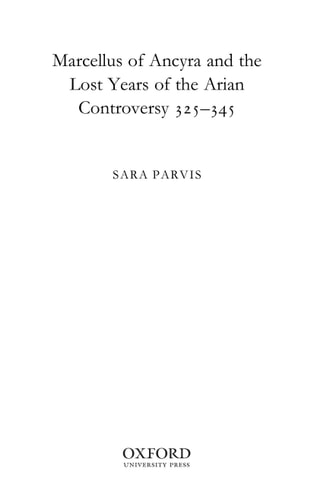
Marcellus of Ancyra and the Lost Years of the Arian Controversy 325-345
0
0
As an Amazon Associate and affiliate partner, Menrva Books earns from qualifying purchases. Learn more
Author Description
Is it true, as has often been claimed in recent years, that there was no real controversy in the period immediately following the Council of Nicaea? Sara Parvis, in this lively and meticulous study, argues not. She shows that the two opposing parties which had formed in support of Alexander of Alexandria and Arius in the years before Nicaea continued their activities afterwards, targeting one another with ruthless zeal at a series of synods which may look neutral but are revealed to be demonstrably partisan. Only the deaths of all the original party leaders except Marcellus of Ancyra, and the rise of Athanasius, broke the impasse which followed and allowed new political and theological configurations to form.
Menrva's Summary
THE THESIS
This study investigates whether the period following the Council of Nicaea was characterized by a lack of theological conflict or by the continuation of deep-seated partisan divisions. Sara Parvis, a scholar of early Christian history, utilizes a rigorous analysis of synodal records and ecclesiastical correspondence to challenge the narrative of post-Nicene stability. She argues that the rivalry between the supporters of Alexander of Alexandria and Arius persisted long after the council, fundamentally shaping the political and theological landscape of the fourth century.
THE SCOPE MAP
What You Will Find
- An analysis of the Arian Controversy between 325 and 345 AD.
- A critical examination of synodal proceedings and their partisan underpinnings.
- Historical evidence regarding the influence of Marcellus of Ancyra on early church politics.
- An evaluation of the transition from original party leaders to the rise of Athanasius.
THE AUTHORITY PERSPECTIVE
Scholars recognize this work as a significant contribution to the study of fourth-century ecclesiastical history, particularly for its detailed re-evaluation of post-Nicene synods. Readers frequently note the academic density of the prose, which is intended for specialists in early Christian theology and history.
Page Count:
304
Publication Date:
2006-05-04
Publisher:
Oxford University Press
ISBN-10:
0199280134
ISBN-13:
9780199280131
Religion
History
Bishops
Trinity
Christianity
Theology
Academic
Arianism
Community Tags
Similar Books