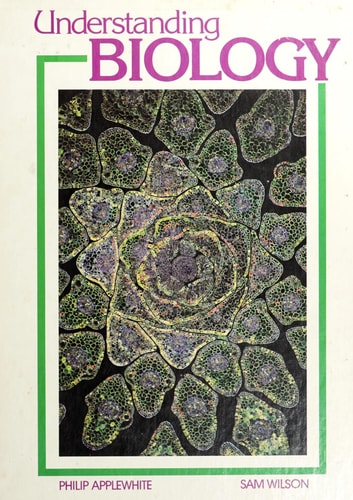
Understanding biology
0
0
As an Amazon Associate and affiliate partner, Menrva Books earns from qualifying purchases. Learn more
Author Description
The authors, a biologist and a professional writer, have chosen evolution and ecology, subjects of general interest, to follow the introductory chapter. Only after the broad scope of biology has been established in the first four chapters do we turn to the biochemical level and begin to describe microstructure of living systems. For those who choose not to approach a survey of biology as we have, the chapters are internally structured so that the order in which they are studied need not follow the order of the book. Of particular interest to non-science students will be the chapters on human sexual biology and disease and aging. These subjects are dealt with in greater detail than in most other texts of this kind. Chapter objectives and summaries offer learning aids to the student. There is an Appendix which includes a glossary and metric tables. A separate study guide is available to assist the student in mastering the course material.
Menrva's Summary
THE THESIS
This text investigates the fundamental principles of biological systems by balancing broad ecological concepts with detailed biochemical analysis. The author, Philip B. Applewhite, utilizes a structured pedagogical approach designed to accommodate both non-science students and those seeking a comprehensive survey of the field. By prioritizing evolution and ecology early in the text, the book establishes a conceptual framework before transitioning into the complexities of microstructure and biochemical processes.
THE SCOPE MAP
What You Will Find
- Introductory chapters covering evolution and ecology
- Detailed sections on human sexual biology, disease, and aging
- Biochemical analysis of living systems
- Learning aids including chapter objectives, summaries, and a glossary
Scope Limits
- The text does not provide advanced research-level data for specialized biological sub-disciplines
- It is not intended as a primary reference for clinical medical practice
THE AUTHORITY PERSPECTIVE
Educators and students frequently note the flexibility of the book's modular chapter structure, which allows for non-linear study paths. The inclusion of specific chapters on human health topics is often cited as a distinct feature that increases accessibility for non-science majors.
Page Count:
466
Publication Date:
1978-01-01
Publisher:
Holt, Rinehart and Winston
ISBN-10:
0030056411
ISBN-13:
9780030056413
Science
Ecology
textbook
New Used & Rental Textbooks
Biology
Evolution
Medicine
Education
Community Tags
Similar Books