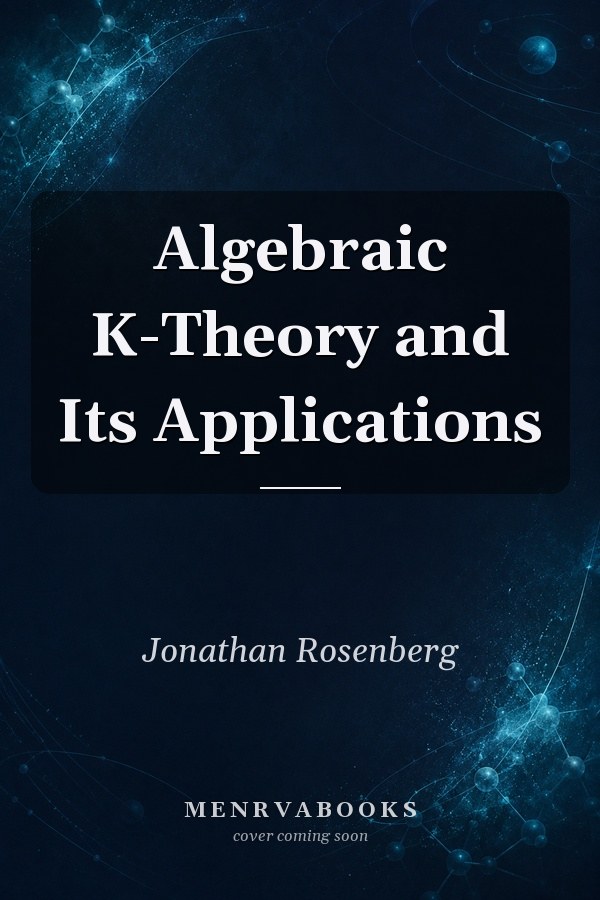
Algebraic K-Theory and Its Applications
0
0
As an Amazon Associate and affiliate partner, Menrva Books earns from qualifying purchases. Learn more
Author Description
Algebraic K-Theory plays an important role in many areas of modern mathematics: most notably algebraic topology, number theory, and algebraic geometry, but even including operator theory. The broad range of these topics has tended to give the subject an aura of inapproachability. This book, based on a course at the University of Maryland in the fall of 1990, is intended to enable graduate students or mathematicians working in other areas not only to learn the basics of algebraic K-Theory, but also to get a feel for its many applications. The required prerequisites are only the standard one-year graduate algebra course and the standard introductory graduate course on algebraic and geometric topology. Many topics from algebraic topology, homological algebra, and algebraic number theory are developed as needed. The final chapter gives a concise introduction to cyclic homology and its interrelationship with K-Theory.
Menrva's Summary
THE THESIS
This book aims to demystify Algebraic K-Theory for graduate students and mathematicians working in other fields. Based on a 1990 course at the University of Maryland, it provides a foundational understanding of Algebraic K-Theory and its diverse applications across algebraic topology, number theory, algebraic geometry, and operator theory. The text develops necessary concepts from algebraic topology, homological algebra, and algebraic number theory as needed, requiring only a standard graduate algebra course and an introductory graduate course on algebraic and geometric topology. The concluding chapter offers an introduction to cyclic homology and its connection to K-Theory.
THE SCOPE MAP
- Foundational concepts of Algebraic K-Theory
- Applications in Algebraic Topology
- Applications in Number Theory
- Applications in Algebraic Geometry
- Applications in Operator Theory
- Development of prerequisite topics in Homological Algebra
- Development of prerequisite topics in Algebraic Number Theory
- Introduction to Cyclic Homology and its relation to K-Theory
THE AUTHORITY PERSPECTIVE
The subject of Algebraic K-Theory is presented as having an aura of inapproachability due to its broad range of applications. This text, however, is designed to make the basics accessible to a wider mathematical audience. The approach taken suggests a text that builds necessary background material, indicating a pedagogical focus. The inclusion of cyclic homology points to a treatment that connects foundational K-Theory with more advanced topics.
Page Count:
408
Publication Date:
2012-01-01
ISBN-10:
1461287359
ISBN-13:
9781461287353
Science
Non-Fiction
Operator Theory
Algebra
Topology
Number Theory
Algebraic Geometry
Community Tags
Similar Books