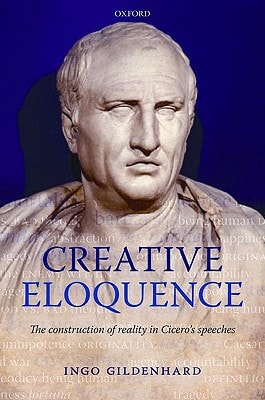
Creative Eloquence: The Construction of Reality in Cicero's Speeches
0
0
As an Amazon Associate and affiliate partner, Menrva Books earns from qualifying purchases. Learn more
Author Description
The statesman Cicero (106-43 BC) left behind a corpus of about 50 orations, all designed as interventions in the legal and political struggles that marked the final decades of the Roman republic. Ever since their publication during his lifetime they have functioned as models of eloquence. However, they also contain profound philosophical thoughts on the question of being human, on politics, society, and culture, and on the sphere of the divine. Now, for the first time, Ingo Gildenhard systematically analyses this dimension of Cicero's oratory and, in so doing, touches upon many key issues and concepts that still preoccupy us today, such as the ethics of happiness or the notion of conscience, the distinction between civilization and barbarity, or the problem of divine justice.
Menrva's Summary
THE THESIS
How does Cicero utilize rhetorical eloquence to construct and negotiate the philosophical and political realities of the late Roman Republic? Ingo Gildenhard, a scholar of classical literature and history, examines the intersection of oratory and philosophy within Cicero's surviving corpus of fifty speeches. By analyzing these texts not merely as political tools but as vehicles for profound inquiry, Gildenhard argues that Cicero's work offers a sophisticated framework for understanding human nature, ethics, and the divine in a volatile historical context.
THE SCOPE MAP
What You Will Find
- A systematic analysis of Cicero's orations as philosophical texts rather than purely legal documents.
- Exploration of core concepts including the ethics of happiness, the nature of conscience, and the definition of civilization.
- Examination of the Roman Republic's final decades and the role of rhetoric in shaping public discourse.
- Discussion on the interplay between divine justice and human political action.
THE AUTHORITY PERSPECTIVE
Scholars and classicists recognize this work as a significant contribution to the study of Ciceronian rhetoric, particularly for its focus on the philosophical underpinnings of his speeches. Readers frequently note the academic density of the prose, which is intended for those with a background in classical history or political philosophy.
Page Count:
450
Publication Date:
2011-01-14
Publisher:
Oxford University Press
ISBN-10:
0199291551
ISBN-13:
9780199291557
History
Philosophy
Rhetoric
Criticism history
Community Tags
Similar Books