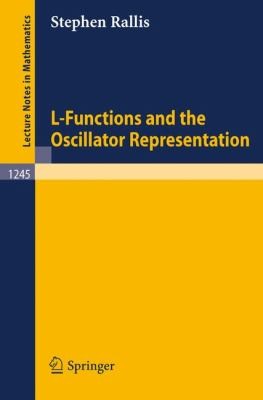
L-Functions and the Oscillator Representation
0
0
As an Amazon Associate and affiliate partner, Menrva Books earns from qualifying purchases. Learn more
Author Description
These notes are concerned with showing the relation between L-functions of classical groups (*F1 in particular) and *F2 functions arising from the oscillator representation of the dual reductive pair *F1 *F3 O(Q). The problem of measuring the nonvanishing of a *F2 correspondence by computing the Petersson inner product of a *F2 lift from *F1 to O(Q) is considered. This product can be expressed as the special value of an L-function (associated to the standard representation of the L-group of *F1) times a finite number of local Euler factors (measuring whether a given local representation occurs in a given oscillator representation). The key ideas used in proving this are (i) new Rankin integral representations of standard L-functions, (ii) see-saw dual reductive pairs and (iii) Siegel-Weil formula. The book addresses readers who specialize in the theory of automorphic forms and L-functions and the representation theory of Lie groups. N
Menrva's Summary
THE THESIS
This work investigates the relationship between L-functions of classical groups and related functions derived from the oscillator representation of dual reductive pairs. The book focuses on measuring the non-vanishing of a correspondence by computing the Petersson inner product of a lift from one group to another. This product is then expressed as the special value of an L-function, multiplied by local Euler factors that indicate the occurrence of specific representations. The core arguments are built upon novel Rankin integral representations, the concept of see-saw dual reductive pairs, and the Siegel-Weil formula.
THE SCOPE MAP
- Exploration of L-functions associated with classical groups, particularly F1.
- Analysis of F2 functions arising from the oscillator representation of dual reductive pairs (F1, F3, O(Q)).
- Methodology for measuring non-vanishing of F2 correspondences via Petersson inner product.
- Expression of the inner product as a special value of an L-function and local Euler factors.
- Detailed exposition of key proof techniques: Rankin integral representations, see-saw dual reductive pairs, and Siegel-Weil formula.
- Targeted at specialists in automorphic forms, L-functions, and representation theory of Lie groups.
THE AUTHORITY PERSPECTIVE
This book is presented as a specialized monograph for advanced researchers in number theory and representation theory. The detailed mathematical exposition, relying on concepts like Rankin integrals and the Siegel-Weil formula, suggests a text of significant depth and technical rigor. Its focus on specific mathematical objects and relationships indicates it is intended for a readership already well-versed in the relevant fields, aiming to contribute to ongoing theoretical developments rather than providing a general introduction.
Page Count:
240
Publication Date:
1987-01-01
ISBN-10:
3540176942
ISBN-13:
9783540176947
Non-Fiction
Science
Representation Theory
Mathematics
Number Theory
Community Tags
Similar Books