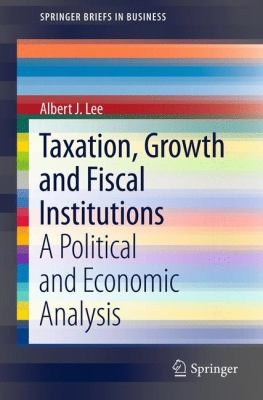
Taxation Growth and Fiscal Institutions
0
0
As an Amazon Associate and affiliate partner, Menrva Books earns from qualifying purchases. Learn more
Author Description
The causal relationship between growth and inequality is complex... Few recent studies in this field have shown that the nature of relationship is multifaceted and non-linear. In addition to the intrinsic nonlinear nature of the relationship, government and institutions play a pivotal role in distributing the benefits of growth to reduce inequality. The responsiveness greatly depends upon a country's initial conditions in terms of inequality and the nature of democracy prevailing in that country. This book highlights the role of institutions in explaining the gulf between inequality and growth. Our method for exploring the role of institutions uses a dynamic general equilibrium framework and econometric techniques. Econometrically, two important hypotheses are tested. First, holding fixed institutions, the growth rate increases as inequality decreases. Second, holding fixed inequality, improvement in the integrity of fiscal institutions results in higher economic growth. This book examines the connections among taxation, growth, and fiscal institutions in an overlapping generations production economy. --Preface.
Menrva's Summary
THE THESIS
This book investigates the intricate connections among taxation, economic growth, and the structure of fiscal institutions. It examines how government and institutions influence the distribution of growth benefits to mitigate inequality, noting that this responsiveness is contingent on a country's initial inequality levels and democratic nature. The work employs a dynamic general equilibrium framework and econometric techniques to explore the role of institutions in the growth-inequality dynamic, testing hypotheses about the inverse relationship between growth and inequality when institutions are fixed, and the positive impact of improved fiscal institutions on growth when inequality is held constant.
THE SCOPE MAP
- Analysis of the causal relationship between economic growth and inequality.
- Exploration of the multifaceted and non-linear nature of this relationship.
- Examination of the pivotal role of government and institutions in distributing growth benefits.
- Use of a dynamic general equilibrium framework and econometric techniques.
- Testing of hypotheses regarding the impact of inequality on growth and fiscal institutions on growth.
- Focus on taxation, growth, and fiscal institutions within an overlapping generations production economy.
THE AUTHORITY PERSPECTIVE
The book's preface outlines its methodological approach, employing econometric techniques and a dynamic general equilibrium framework to analyze complex economic relationships. The focus on the interplay between taxation, growth, and fiscal institutions suggests a text aimed at specialists in public finance and economic policy. The examination of hypotheses concerning inequality and institutional integrity points to a rigorous, data-driven analysis intended for an academic audience.
Page Count:
61
Publication Date:
2011-01-01
ISBN-10:
1461412897
ISBN-13:
9781461412892
Non-Fiction
Economics
Fiscal Policy
Econometrics
Public Finance
Economic Growth
Community Tags
Similar Books