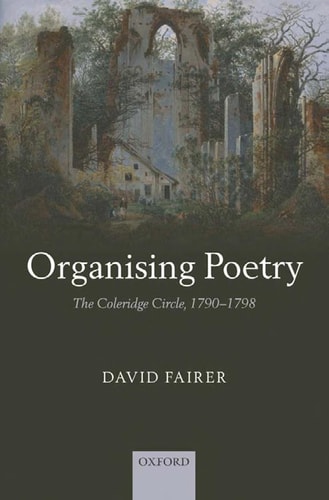
Organising Poetry: The Coleridge Circle, 1790-1798
0
0
As an Amazon Associate and affiliate partner, Menrva Books earns from qualifying purchases. Learn more
Author Description
In this revisionary study of the poetry of Coleridge, Wordsworth and their friends during the 'revolutionary decade' David Fairer questions the accepted literary history of the period and the critical vocabulary we use to discuss it. The book examines why, at a time of radical upheaval when continuities of all kinds (personal, political, social, and cultural) were being challenged, this group of poets explored themes of inheritance, retrospect, revisiting, and recovery. Organising Poetry charts their struggles to find meaning not through vision and symbol but from connection and dialogue. By placing these poets in the context of an eighteenth-century 'organic' tradition, Fairer moves the emphasis away from the language of idealist 'Romantic' theory towards an empirical stress on how identities are developed and sustained through time. Locke's concept of personal identity as a continued organisation 'partaking of one common life' offered not only a model for a reformed British constitution but a way of thinking about the self, art and friendship, which these poets found valuable. The key term, therefore, is not 'unity' but 'integrity'. In this context of a need to sustain and organise diversity and give it meaning, the book offers original readings of some well known poems of the 1790s, including Wordsworth's 'Tintern Abbey' and 'The Ruined Cottage', and Coleridge's conversation poems 'The Eolian Harp', 'This Lime-Tree Bower', and 'Frost at Midnight'. Organising Poetry represents an important contribution to current critical debates about the nature of poetic creativity during this period and the need to recognise its more communal and collaborative aspects.
Menrva's Summary
THE THESIS
This study investigates how the Coleridge circle navigated the radical political and social upheavals of the 1790s by re-evaluating their poetic focus on connection, dialogue, and personal integrity. David Fairer, a scholar of eighteenth-century literature, challenges traditional Romantic theory by situating these poets within an empirical, organic tradition. He argues that the poets utilized John Locke’s concept of personal identity to reconcile the need for continuity in a decade defined by fragmentation and revolutionary change.
THE SCOPE MAP
What You Will Find
- Analysis of the 'revolutionary decade' of the 1790s in British history.
- Application of Locke’s philosophical framework of personal identity to poetic structure.
- Close readings of seminal works including 'Tintern Abbey', 'The Ruined Cottage', and 'The Eolian Harp'.
- A critical re-examination of the 'organic' tradition versus idealist Romantic theory.
THE AUTHORITY PERSPECTIVE
Scholars recognize this work as a significant intervention in the study of Romantic-era poetry, particularly for its emphasis on the communal and collaborative nature of the Coleridge circle. Readers frequently note the academic density of the prose and the author's success in shifting critical focus from abstract symbolism to historical and empirical contexts.
Page Count:
352
Publication Date:
2009-08-17
Publisher:
Oxford University Press
ISBN-10:
0199296162
ISBN-13:
9780199296163
Poetry
History
Literary Criticism
British literature
Romanticism
Community Tags
Similar Books