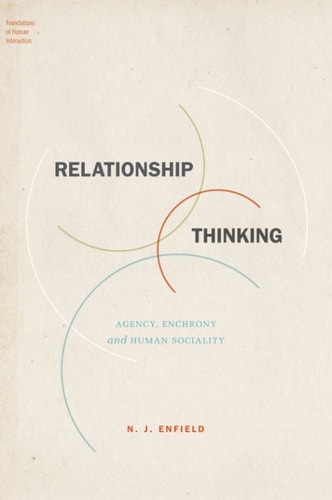
Relationship Thinking: Agency, Enchrony, and Human Sociality
0
0
As an Amazon Associate and affiliate partner, Menrva Books earns from qualifying purchases. Learn more
Author Description
In Relationship Thinking, N. J. Enfield outlines a framework for analyzing social interaction and its linguistic, cultural, and cognitive underpinnings by focusing on human relationships. This is a naturalistic approach to human sociality, grounded in the systematic study of real-time data from social interaction in everyday life. Many of the illustrative examples and analyses in the book are a result of the author's long-term field work in Laos. Enfield promotes an interdisciplinary approach to studying language, culture, and mind, building on simple but powerful semiotic principles and concentrating on three points of conceptual focus. The first is human agency: the combination of flexibility and accountability, which defines our possibilities for social action and relationships, and which makes the fission and fusion of social units possible. The second is enchrony: the timescale of conversation in which our social relationships are primarily enacted. The third is human sociality: a range of human propensities for social interaction and enduring social relations, grounded in collective commitment to shared norms. Enfield's approach cuts through common dichotomies such as 'cognitive' versus 'behaviorist', or 'public' versus 'private', arguing instead that these are indispensable sides of single phenomena. The result is a set of conceptual tools for analyzing real-time social interaction and linking it with enduring relationships and their social contexts. The book shows that even - or perhaps especially - the most mundane social interactions yield rich insights into language, culture, and mind.
Menrva's Summary
THE THESIS
This book investigates the fundamental mechanisms of human sociality by proposing a framework that links real-time interaction to the formation of enduring relationships. N. J. Enfield, a professor of linguistics, draws upon extensive field research in Laos and interdisciplinary synthesis to argue that agency, enchrony, and sociality are interconnected phenomena. By moving beyond traditional dichotomies like public versus private, the author provides a set of conceptual tools designed to analyze how mundane conversations sustain complex social structures.
THE SCOPE MAP
What You Will Find
- A detailed analysis of human agency as a balance between behavioral flexibility and social accountability.
- The introduction of enchrony as a specific timescale for understanding the mechanics of conversational interaction.
- Empirical evidence derived from long-term ethnographic fieldwork and linguistic data collection.
- A theoretical framework for connecting micro-level social interactions to macro-level cultural and cognitive norms.
THE AUTHORITY PERSPECTIVE
Scholars in the fields of linguistic anthropology and social cognition identify this work as a significant contribution to the study of human interaction. Readers frequently note the academic density of the prose, which serves as a foundational text for those examining the intersection of language, culture, and mind.
Page Count:
304
Publication Date:
2013-01-01
Publisher:
Oxford University Press
ISBN-10:
0199338744
ISBN-13:
9780199338740
Communication
Linguistics
Cognition
Social Science
English & College Success
English
Anthropology
Sociology
Semiotics
Community Tags
Other Editions(2)

Similar Books