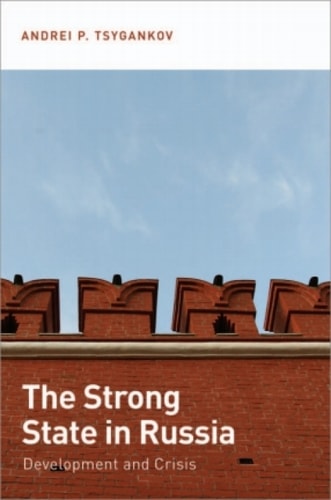
The Strong State in Russia: Development and Crisis
0
0
As an Amazon Associate and affiliate partner, Menrva Books earns from qualifying purchases. Learn more
Author Description
The Russian state presents a mystery to outside observers. Although Russia was the site of some of the last century's most radical upheavals, and although Russian governments are usually characterized by autocracy, corruption, and political decay, the central government has retained a remarkable hold on the vast country. Does its historical progress represent change, or continuity? How has the political culture molded the expectations and behavior of the Russian people over time? What features of the Russian state are the keys to understanding it?The Strong State in Russia provides a succinct account of Russia's "strong state" model by reviewing the external and internal contexts in each major period and tracing its evolution over time. Every era saw the emergence and growth of a strong state as well as a subsequent decline, but in each the contexts combined in unique ways to produce very different political outcomes. Tsygankov argues that while the Western perspective on Russia is limited, there is an alternative way of thinking about the nation and its problems. Despite focusing on the contemporary Russian state, the book situates it in a broader historical continuity and explains that the roots of its development can be found in the Tsar's autocratic system. Russia's strong state has evolved and survived throughout centuries, and that alone suggests its historical vitality and possible future revival. From this perspective, the central scholarly question is not whether Russia will recreate a strong state, but, rather, what kind of a strong state it will be, and under which circumstances it will likely function.
Menrva's Summary
THE THESIS
This book investigates the historical evolution and persistent nature of the Russian strong state model to determine whether its development represents fundamental change or long-term continuity. Andrei P. Tsygankov, a professor of international relations and political science, utilizes a historical-institutional framework to analyze how political culture and external pressures have shaped the Russian state from the Tsarist era to the contemporary period. He argues that the recurring pattern of state strength followed by decline is a defining feature of the nation's political trajectory, suggesting that the state's survival is rooted in deep-seated historical structures rather than mere political decay. The work challenges Western-centric interpretations by proposing an alternative lens through which to view the state's capacity for revival and adaptation.
THE SCOPE MAP
What You Will Find
- Historical analysis of the Russian state from the Tsarist autocratic system to the modern era.
- Examination of the cyclical patterns of state strength and subsequent decline across different political regimes.
- Evaluation of how political culture influences public expectations and government behavior.
- Comparative assessment of internal and external contexts that drive state evolution.
THE AUTHORITY PERSPECTIVE
Scholars and political analysts frequently cite this work as a valuable contribution to understanding the structural resilience of the Russian government. Readers often note the academic rigor of the prose, which provides a necessary counterpoint to common Western narratives regarding Russian political development.
Page Count:
272
Publication Date:
2014-01-01
Publisher:
Oxford University Press
ISBN-10:
0199336229
ISBN-13:
9780199336227
History
Comparative Politics
International relations
European History
Russia
Authoritarianism
State The
Despotism
Government
Community Tags
Similar Books