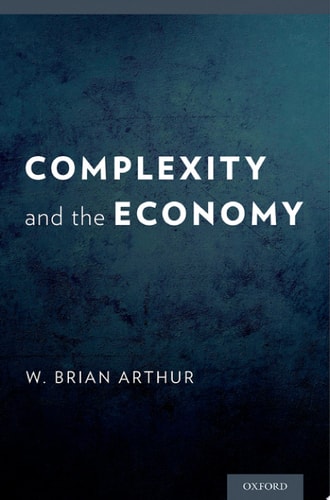
Complexity and the Economy
0
0
As an Amazon Associate and affiliate partner, Menrva Books earns from qualifying purchases. Learn more
Author Description
Economics Is Changing. In The Last Few Years It Has Generated A Number Of New Approaches. One Of The Most Promising - Complexity Economics - Was Pioneered In The 1980s And 1990s By A Small Team At The Santa Fe Institute. Economist And Complexity Theorist W. Brian Arthur Led That Team, And In This Book He Collects Many Of His Articles On This New Approach. The Traditional Framework Sees Behavior In The Economy As In An Equilibrium Steady State. People In The Economy Face Well-defined Problems And Use Perfect Deductive Reasoning To Base Their Actions On. The Complexity Framework, By Contrast, Sees The Economy As Always In Process, Always Changing. People Try To Make Sense Of The Situations They Face Using Whatever Reasoning They Have At Hand, And Together Create Outcomes They Must Individually React To Anew. The Resulting Economy Is Not A Well-ordered Machine, But A Complex Evolving System That Is Imperfect, Perpetually Constructing Itself Anew, And Brimming With Vitality. The New Vision Complements And Widens The Standard One, And It Helps Answer Many Questions: Why Does The Stock Market Show Moods And A Psychology? Why Do High-tech Markets Tend To Lock In To The Dominance Of One Or Two Very Large Players? How Do Economies Form, And How Do They Continually Alter In Structure Over Time? The Papers Collected Here Were Among The First To Use Evolutionary Computation, Agent-based Modeling, And Cognitive Psychology. They Cover Topics As Disparate As How Markets Form Out Of Beliefs; How Technology Evolves Over The Long Span Of Time; Why Systems And Bureaucracies Get More Complicated As They Evolve; And How Financial Crises Can Be Foreseen And Prevented In The Future.
Menrva's Summary
THE THESIS
This book investigates the shift from equilibrium-based economic models to a framework that views the economy as a complex, perpetually evolving system. W. Brian Arthur, a prominent economist and complexity theorist, draws upon his foundational work at the Santa Fe Institute to challenge traditional assumptions of perfect rationality and steady-state equilibrium. By integrating insights from cognitive psychology and evolutionary computation, Arthur argues that economic systems are dynamic processes characterized by constant change and emergent behavior.
THE SCOPE MAP
What You Will Find
- Agent-based modeling and evolutionary computation methodologies
- Analysis of market formation based on individual beliefs and reasoning
- Examination of technological evolution over long historical spans
- Theoretical frameworks for understanding financial crises and market dominance
THE AUTHORITY PERSPECTIVE
Experts recognize this collection as a foundational text for understanding the development of complexity economics. Readers frequently note the technical density of the prose, which serves as a primary resource for those interested in the intersection of systems theory and economic policy.
Page Count:
192
Publication Date:
2014-01-01
Publisher:
Oxford University Press, Incorporated
ISBN-10:
0199334307
ISBN-13:
9780199334308
Science
Business
Economics
Technology
Complexity Theory
Economics
Community Tags
Similar Books