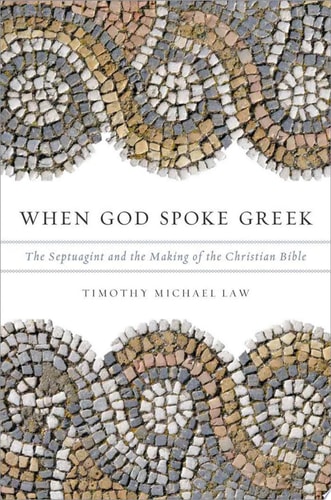
When God Spoke Greek: The Septuagint and the Making of the Christian Bible
0
0
As an Amazon Associate and affiliate partner, Menrva Books earns from qualifying purchases. Learn more
Author Description
How did the New Testament writers and the earliest Christians come to adopt the Jewish scriptures as their first Old Testament? And why are our modern Bibles related more to the Rabbinic Hebrew Bible than to the Greek Bible of the early Church?The Septuagint, the name given to the translation of the Hebrew scriptures between the third century BC and the second century AD, played a central role in the Bible's history. Many of the Hebrew scriptures were still evolving when they were translated into Greek, and these Greek translations, along with several new Greek writings, became Holy Scripture in the early Church. Yet, gradually the Septuagint lost its place at the heart of Western Christianity. At the end of the fourth century, one of antiquity's brightest minds rejected the Septuagint in favor of the Bible of the rabbis. After Jerome, the Septuagint never regained the position it once had. Timothy Michael Law recounts the story of the Septuagint's origins, its relationship to the Hebrew Bible, and the adoption and abandonment of the first Christian Old Testament.
Menrva's Summary
THE THESIS
This book investigates the historical transition of the Christian Old Testament from the Greek Septuagint to the Rabbinic Hebrew Bible. Timothy Michael Law, a scholar of early Christianity and biblical history, examines the evolution of these texts during the formative centuries of the Church. He argues that the early Church's reliance on the Septuagint was fundamental to its identity, and he analyzes the theological and historical motivations behind the eventual shift toward the Hebrew canon championed by Jerome.
THE SCOPE MAP
What You Will Find
- The historical origins and development of the Septuagint between the third century BC and the second century AD.
- An analysis of the textual evolution of Hebrew scriptures during their translation into Greek.
- A detailed account of the influence of Jerome and the subsequent marginalization of the Greek Bible in Western Christianity.
- A comparative study of the Greek Bible versus the Rabbinic Hebrew Bible as foundational texts for early Christian communities.
THE AUTHORITY PERSPECTIVE
Scholars and students of theology frequently cite this work as a clear and accessible introduction to the complex history of the biblical canon. Experts highlight the text for its ability to synthesize dense historical data into a coherent narrative regarding the shifting priorities of the early Church.
Page Count:
240
Publication Date:
2013-01-01
Publisher:
Oxford University Press
ISBN-10:
0199344337
ISBN-13:
9780199344338
Religion
History
Theology
Bible versions
Christianity
Bibles
Community Tags
Similar Books









![Old Scofield Study Bible-KJV-Large Print [Large Print]](https://storage.googleapis.com/menrva_img_storage/covers/9780195272550_eb3d57c8.jpg)

