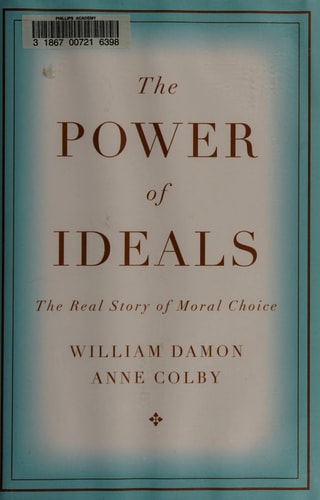
The Power of Ideals: The Real Story of Moral Choice
0
0
As an Amazon Associate and affiliate partner, Menrva Books earns from qualifying purchases. Learn more
Author Description
Cynicism often seems a smarter choice than idealism. There are reasons for this. Politicians have disappointed us time and again; trusted institutions have proven to be self-serving and corrupt; hopes for lasting world peace repeatedly have been dashed; and social inequities persist and increase, unabated by even the grandest of charitable efforts. It is now considered foolish to think that people can be counted on to rise above their narrow self-interests to serve the broader good, or to tell the truth if it does not reflect well on the self. Supporting this bleak view of the human condition is a moral psychology that has taken increasingly cynical turns in recent years. Famous studies have shown that we have an almost unlimited potential for cruelty when placed in the wrong situations.The Power of Ideals presents a different vision, supported by a different kind of evidence. It examines the lives and work of six 20th century moral leaders who pursued moral causes ranging from world peace to social justice and human rights. Using these six cases to illustrate how people can make choices guided by their moral convictions, rather than by base emotion or social pressures, authors William Damon and Anne Colby explore the workings of three virtues: inner truthfulness, humility, and faith. Through their portrayal of the noble lives of moral leaders, the authors argue that all of us--with ordinary lives--can exercise control over important life decisions and pursue ideals that we believe in.
Menrva's Summary
THE THESIS
This book investigates whether human beings possess the capacity to act upon moral convictions rather than succumbing to self-interest or cynical social pressures. Authors Anne Colby and William Damon, both established scholars in the field of moral development, challenge the prevailing psychological consensus that emphasizes human cruelty and situational conformity. By analyzing the lives of six prominent 20th-century moral leaders, they construct a framework that demonstrates how individuals can cultivate virtues like truthfulness, humility, and faith to guide their decision-making processes.
THE SCOPE MAP
What You Will Find
- Biographical case studies of six 20th-century figures dedicated to social justice, human rights, and peace.
- A psychological framework identifying three core virtues: inner truthfulness, humility, and faith.
- Comparative analysis between historical moral leadership and contemporary cynical psychological theories.
- Practical applications for ordinary individuals to exercise agency in their own moral choices.
THE AUTHORITY PERSPECTIVE
Experts frequently cite this work as a significant counter-narrative to the situationalist perspectives that dominated late 20th-century moral psychology. Readers often note the accessible prose style, which balances academic rigor with biographical storytelling to make complex ethical concepts applicable to daily life.
Page Count:
240
Publication Date:
2015-05-01
Publisher:
Oxford University Press
ISBN-10:
0199357749
ISBN-13:
9780199357741
Psychology
Philosophy
Biography
Ethics
Social Science
Community Tags
Similar Books