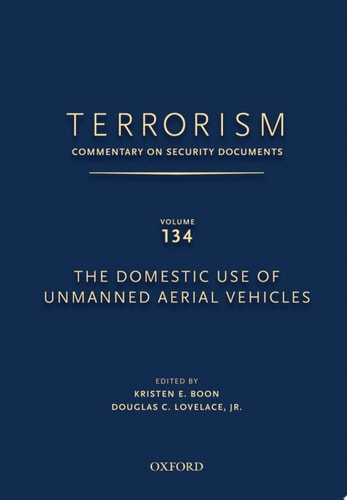
Terrorism: Commentary on Security Documents, Volume 134: The Domestic Use of Unmanned Aerial Vehicles
0
0
As an Amazon Associate and affiliate partner, Menrva Books earns from qualifying purchases. Learn more
Author Description
Terrorism: Commentary on Security Documents is a series that provides primary source documents and expert commentary on various topics relating to the worldwide effort to combat terrorism. Among the documents collected are transcripts of Congressional testimony, reports by such federal government bodies as the Congressional Research Service (CRS) and the Government Accountability Office (GAO), United Nations Security Council resolutions, reports and investigations by the United Nations Secretary-General and other dedicated UN bodies, and case law from the U.S. and around the globe covering issues related to terrorism. Most volumes focus on a single theme, and inside each volume the documents usually appear within topic-based categories. The series also includes a subject index and other indices that guide the user through this complex area of the law.Volume 134, The Domestic Use of Unmanned Aerial Vehicles, examines an issue that is just now beginning to emerge as a subject of public debate, as the implications of new technological capabilities begin to become clear and the legal limits of the uses of those technologies begin to be tested. Professor Douglas C. Lovelace, Jr., who has provided the introductory commentary to this volume, has selected several illuminating documents that examine various aspects of this issue. These documents consider the expanding use of unmanned aerial vehicles (or drones) for surveillance activities by both border enforcement and domestic law enforcement officials; the privacy implications of the potentially highly intrusive surveillance capabilities of drone technology; and concerns that drones will be used for non-surveillance purposes within U.S. borders. Other topics include the state of the unmanned aircraft manufacturing sector in the U.S., the legal implications of the integration of drones into domestic airspace, and the constitutional implications of the expanding use of facial recognition technology.
Menrva's Summary
THE THESIS
This volume investigates the legal, constitutional, and privacy implications surrounding the integration of unmanned aerial vehicles (UAVs) into domestic United States airspace. Douglas Lovelace Jr. and Kristen E. Boon curate a collection of primary source documents, including Congressional testimony and federal reports, to analyze how emerging drone technology challenges existing regulatory frameworks. The text provides a structured examination of the tension between technological surveillance capabilities and individual civil liberties.
THE SCOPE MAP
What You Will Find
- Primary source documentation from the Congressional Research Service and the Government Accountability Office.
- Analysis of the legal and constitutional boundaries regarding domestic drone surveillance.
- Examination of the unmanned aircraft manufacturing sector and its economic impact.
- Discussion on the integration of facial recognition technology within domestic law enforcement operations.
THE AUTHORITY PERSPECTIVE
Experts and legal researchers utilize this series as a foundational resource for tracking the evolution of counter-terrorism and security policy. Readers frequently note the high density of the primary source material, which serves as a comprehensive reference for those studying the intersection of technology and domestic law.
Page Count:
328
Publication Date:
2014-01-01
Publisher:
Oxford University Press
ISBN-10:
0199351058
ISBN-13:
9780199351053
Government
Drone Aircraft
Security
Technology
United States
Law
Reference
Terrorism
Community Tags
Similar Books










Reader Comments
Share Your Thoughts
No comments yet. Be the first to share your thoughts!