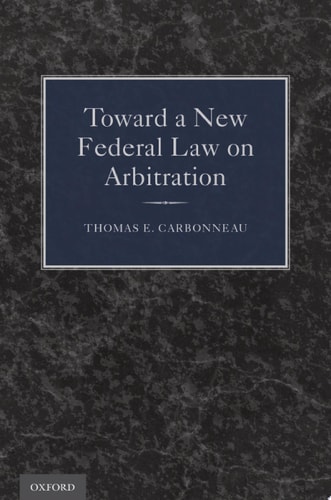
Toward a New Federal Law on Arbitration
0
0
As an Amazon Associate and affiliate partner, Menrva Books earns from qualifying purchases. Learn more
Author Description
Enacted as a special interest bill in 1925, the Federal Arbitration Act (FAA) positioned arbitration well among specialized merchant communities. Its principles relating to the legitimacy of arbitration contracts and the limited judicial supervision of arbitral awards laid the foundation for a more detailed and effective legal regulation of arbitration. Despite the advanced character of its original content, the FAA was never significantly updated by the U.S. Congress, and the standing statutory provisions did not take into account the widening scope of arbitral jurisdiction and its revolutionary impact upon adjudicatory due process. Thus, the task of adjusting the statute to new realities became the responsibility of the U. S. Supreme Court, exercising its duty over a half century and more than fifty cases with the ultimate goal to fulfill the expectations of U.S. citizenship and protect U.S. interests in global commerce. Toward a New Federal Law on Arbitration endeavors to repair the long-standing problem of updating the official text of the Federal Arbitration Act (FAA). In this book, Thomas E. Carbonneau proposes to transform the FAA into a genuine national law of arbitration, based exclusively on the federal rules applicable to arbitration. He argues for necessary change in the federal law of arbitration that will not only benefit commercial interests and the U.S. economy, but also provide protection for smaller individual interests, such as consumers and employees. This book joins the U.S. Supreme Court in proclaiming that judicial litigation is flawed. In the process, this book describes the current federal law on arbitration, provides and explains the provisions of the proposed law, while setting the stage for future adjudicatory practice.
Menrva's Summary
THE THESIS
This book investigates the urgent need to modernize the 1925 Federal Arbitration Act to address contemporary legal realities and the expansion of arbitral jurisdiction. Thomas E. Carbonneau, a recognized authority on arbitration law, examines how the original statute has become outdated due to congressional inaction and the subsequent reliance on judicial interpretation by the U.S. Supreme Court. He presents a comprehensive proposal to transform the existing framework into a cohesive national law that balances commercial interests with the protection of individual rights for consumers and employees.
THE SCOPE MAP
What You Will Find
- A critical analysis of the historical development and limitations of the 1925 Federal Arbitration Act.
- A detailed proposal for a new, updated federal law of arbitration based on current federal rules.
- An examination of over fifty U.S. Supreme Court cases that have shaped modern arbitral practice.
- A discussion on the impact of arbitration on due process, commercial interests, and individual consumer and employee rights.
THE AUTHORITY PERSPECTIVE
Legal scholars and practitioners view this work as a significant contribution to the discourse on statutory reform in the United States. Experts frequently highlight the text for its clear articulation of the tension between historical legislative intent and modern judicial application.
Page Count:
288
Publication Date:
2014-01-01
Publisher:
Oxford University Press
ISBN-10:
0199366918
ISBN-13:
9780199366910
Professional Career & Trade
Legal Studies
Arbitration
Arbitration and award
Law
Public Policy
Community Tags
Similar Books