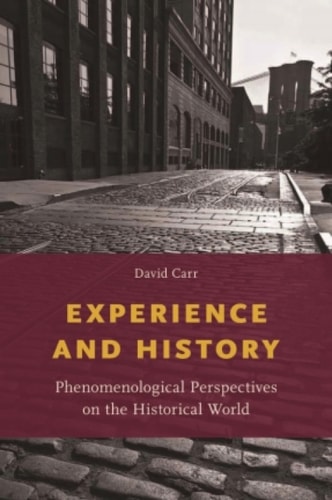
Experience and History: Phenomenological Perspectives on the Historical World
0
0
As an Amazon Associate and affiliate partner, Menrva Books earns from qualifying purchases. Learn more
Author Description
David Carr outlines a distinctively phenomenological approach to history. Rather than asking what history is or how we know history, a phenomenology of history inquires into history as a phenomenon and into the experience of the historical. How does history present itself to us, how does it enter our lives, and what are the forms of experience in which it does so? History is usually associated with social existence and its past, and so Carr probes the experience of the social world and of its temporality. Experience in this context connotes not just observation but also involvement and interaction: We experience history not just in the social world around us but also in our own engagement with it. For several decades, philosophers' reflections on history have been dominated by two themes: representation and memory. Each is conceived as a relation to the past: representation can be of the past, and memory is by its nature of the past. On both of these accounts, history is separated by a gap from what it seeks to find or wants to know, and its activity is seen by philosophers as that of bridging this gap. This constitutes the problem to which the philosophy of history addresses itself: how does history bridge the gap which separates it from its object, the past? It is against this background that a phenomenological approach, based on the concept of experience, can be proposed as a means of solving this problem-or at least addressing it in a way that takes us beyond the notion of a gap between present and past.
Menrva's Summary
THE THESIS
This work investigates how history manifests as a lived phenomenon rather than merely an object of academic representation or memory. David Carr, a scholar of phenomenology, challenges the traditional philosophical view that history is separated from the present by an unbridgeable gap. By shifting the focus from historical reconstruction to the experience of temporality and social existence, Carr argues that history is an active component of our ongoing engagement with the world.
THE SCOPE MAP
What You Will Find
- A phenomenological analysis of historical temporality and social existence.
- A critique of representational and memory-based models of historical inquiry.
- An examination of how individuals interact with and participate in the historical world.
- A framework for understanding history as an integrated aspect of human experience rather than a distant past.
THE AUTHORITY PERSPECTIVE
Experts recognize this text as a significant contribution to the philosophy of history, particularly for those interested in the intersection of Husserlian phenomenology and historical theory. Readers frequently note the academic density of the prose, which requires a foundational understanding of phenomenological concepts to fully grasp the author's arguments.
Page Count:
256
Publication Date:
2014-01-01
Publisher:
Oxford University Press
ISBN-10:
0199377669
ISBN-13:
9780199377664
Philosophy
History
Phenomenology
Social Science
Community Tags
Similar Books