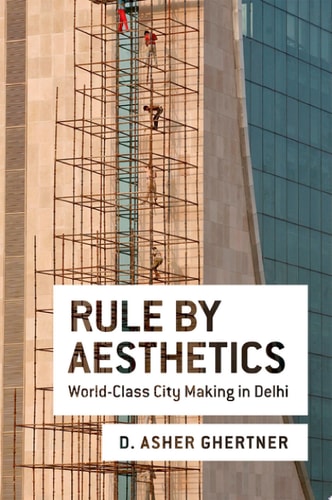
Rule By Aesthetics: World-Class City Making in Delhi
0
0
As an Amazon Associate and affiliate partner, Menrva Books earns from qualifying purchases. Learn more
Author Description
Rule by Aesthetics offers a powerful examination of the process and experience of mass demolition in the world's second largest city of Delhi, India. Using Delhi's millennial effort to become a 'world-class city,' the book shows how aesthetic norms can replace the procedures of mapping and surveying typically considered necessary to administer space. This practice of evaluating territory based on its adherence to aesthetic norms - what Ghertner calls 'rule by aesthetics' - allowed the state in Delhi to intervene in the once ungovernable space of slums, overcoming its historical reliance on inaccurate maps and statistics. Slums hence were declared illegal because they looked illegal, an arrangement that led to the displacement of a million slum residents in the first decade of the 21st century.Drawing on close ethnographic engagement with the slum residents targeted for removal, as well as the planners, judges, and politicians who targeted them, the book demonstrates how easily plans, laws, and democratic procedures can be subverted once the subjects of democracy are seen as visually out of place. Slum dwellers' creative appropriation of dominant aesthetic norms shows, however, that aesthetic rule does not mark the end of democratic claims making. Rather, it signals a new relationship between the mechanism of government and the practice of politics, one in which struggles for a more inclusive city rely more than ever on urban aesthetics, in Delhi as in aspiring world-class cities the world over.
Menrva's Summary
THE THESIS
This book investigates how the pursuit of a 'world-class' urban aesthetic allows state authorities to bypass traditional legal and administrative procedures to justify mass displacement. D. Asher Ghertner, an expert in urban geography and political ecology, utilizes extensive ethnographic research conducted in Delhi to analyze the intersection of visual perception and governance. He argues that when the state adopts aesthetic norms as a primary tool for urban planning, it effectively renders marginalized populations 'illegal' based on visual cues rather than documented land rights or statistical data.
THE SCOPE MAP
What You Will Find
- Analysis of the 'world-class city' development model in Delhi during the early 21st century.
- Examination of how visual aesthetics replace traditional mapping and surveying in urban administration.
- Ethnographic case studies involving slum residents, city planners, judicial officials, and politicians.
- Theoretical framework regarding the subversion of democratic procedures through visual judgment.
THE AUTHORITY PERSPECTIVE
Scholars in urban studies and political geography recognize this work as a significant contribution to the study of post-colonial urbanism and the politics of space. Readers frequently note the academic density of the prose, which provides a rigorous critique of how visual perception influences state power and democratic participation.
Page Count:
272
Publication Date:
2015-09-21
Publisher:
Oxford University Press
ISBN-10:
0199385572
ISBN-13:
9780199385577
Slums
Urban Studies
Urban renewal
Sociology
Geography
India
City Planning
Community Tags
Similar Books