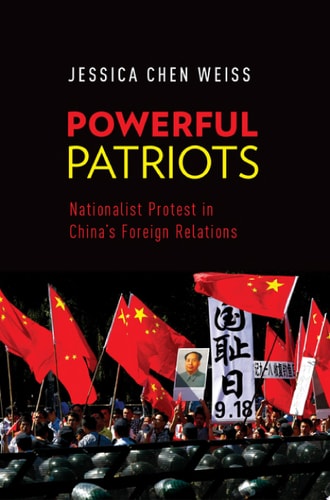
Powerful Patriots: Nationalist Protest in China's Foreign Relations
0
0
As an Amazon Associate and affiliate partner, Menrva Books earns from qualifying purchases. Learn more
Author Description
What role do nationalism and popular protest play in China's foreign relations? Chinese authorities permitted anti-American demonstrations in 1999 but repressed them in 2001 during two crises in U.S.-China relations. Anti-Japanese protests were tolerated in 1985, 2005, and 2012 but banned in 1990 and 1996. Protests over Taiwan, the issue of greatest concern to Chinese nationalists, have never been allowed. To explain this variation, Powerful Patriots identifies the diplomatic as well as domestic factors that drive protest management in authoritarian states. Because nationalist protests are costly to repress and may turn against the government, allowing protests demonstrates resolve and makes compromise more costly in diplomatic relations. Repressing protests, by contrast, sends a credible signal of reassurance, facilitating diplomatic flexibility. Powerful Patriots traces China's management of dozens of nationalist protests and their consequences between 1985 and 2012.
Menrva's Summary
THE THESIS
This book investigates the strategic logic behind the Chinese government's inconsistent management of nationalist protests in the context of its foreign policy. Jessica Chen Weiss, a scholar of international relations, utilizes a framework of signaling to explain why authoritarian regimes choose to either permit or suppress popular demonstrations. By analyzing the diplomatic costs and domestic risks associated with public dissent, the author argues that protest management serves as a tool for signaling resolve or reassurance to foreign powers.
THE SCOPE MAP
What You Will Find
- A comprehensive analysis of Chinese nationalist protests occurring between 1985 and 2012.
- A theoretical framework explaining the signaling function of public demonstrations in authoritarian states.
- Comparative case studies of protests regarding U.S.-China relations, Japan, and Taiwan.
- An examination of the trade-offs between domestic political stability and international diplomatic flexibility.
THE AUTHORITY PERSPECTIVE
Experts in the field of Chinese politics and international relations identify this work as a foundational text for understanding the intersection of domestic nationalism and foreign policy. Readers frequently note the clarity of the author's theoretical model and the rigor of the historical data presented.
Page Count:
360
Publication Date:
2014-01-01
Publisher:
Oxford University Press
ISBN-10:
0199387559
ISBN-13:
9780199387557
History
Sociology
Demonstrations
International relations
China
Government
Community Tags
Similar Books