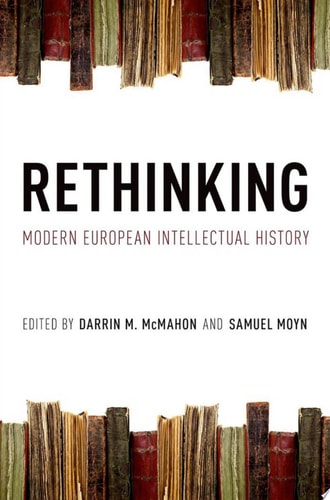
Rethinking Modern European Intellectual History
0
0
As an Amazon Associate and affiliate partner, Menrva Books earns from qualifying purchases. Learn more
Author Description
Modern European intellectual history is thriving as never before. It has recovered from an era in which other trends like social and cultural history threatened to marginalize it. But in spite of enjoying a contemporary renaissance, the field has lost touch with the tradition of debating why and how to study ideas and thus lacks both a well-articulated set of purposes and a range of arguments for exactly what it means to pursue those purposes. This volume revives that tradition.Recalling past attempts to showcase the diversity and differentiation of modern European intellectual history, this volume also documents how much has changed in recent decades. Some authors are much readier to defend a history of ideas practiced over the long term - once the defining sin of the field. Others go so far as to insist on how ideas are always open to reappropriation and reevaluation beyond their original contexts - suggesting that it is an error to reduce the ideas to those contexts. Others still argue that, under threat from trends like social history, intellectual historians have forsaken any attempt to resolve for themselves how ideas are socially embodied.The volume also registers old and new trends in history that have affected the study of ideas, including the history of science, the history of academic disciplines, the history of psychology and "self," international and global history, and women's and gender history.
Menrva's Summary
THE THESIS
This volume investigates the current state and future purpose of modern European intellectual history, questioning how the field can reclaim its tradition of debating the study of ideas. Editors Darrin M. McMahon and Samuel Moyn curate a collection of essays that address the field's recent renaissance and its simultaneous loss of a well-articulated methodological purpose. By examining the tension between long-term historical analysis and context-bound interpretation, the contributors argue for a more robust framework for understanding how ideas are socially embodied and historically transmitted. The text serves as a critical intervention for scholars seeking to navigate the intersection of traditional intellectual history and contemporary historiographical trends.
THE SCOPE MAP
What You Will Find
- Methodological debates regarding the long-term study of ideas versus context-specific analysis.
- Analysis of how intellectual history intersects with the history of science, psychology, and academic disciplines.
- Exploration of the impact of social, cultural, and gender history on the study of ideas.
- Arguments concerning the reappropriation and reevaluation of historical ideas beyond their original contexts.
THE AUTHORITY PERSPECTIVE
Scholars and historians frequently cite this volume as a critical reference for understanding the evolution of modern intellectual history. Experts highlight the text as a necessary resource for students and researchers navigating the shifting boundaries between traditional historical inquiry and modern interdisciplinary approaches.
Page Count:
315
Publication Date:
2014-01-01
Publisher:
Oxford University Press
ISBN-10:
0199397511
ISBN-13:
9780199397518
Philosophy
History
European History
Intellectual History
Historiography
Learning and scholarship
Modern History
Community Tags
Similar Books