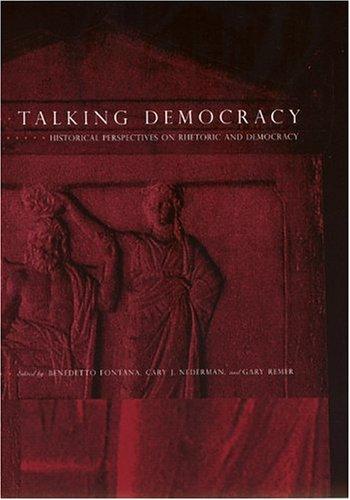
Talking Democracy
0
0
As an Amazon Associate and affiliate partner, Menrva Books earns from qualifying purchases. Learn more
Author Description
In their efforts to uncover the principles of a robust conception of democracy, theorists of deliberative democracy place a premium on the role of political expression - public speech and reasoned debate - as the key to democratic processes. They also frequently hark back to historical antecedents (as in the Habermasian invocation of the "public sphere" of eighteenth-century bourgeois society and the Arendtian valorization of the classical Athenian polis) in their quest to establish that deliberative procedures are more than "merely theoretical" and instead have a practical application. But for all this emphasis on the discursive and historical dimensions of democracy, these theorists have generally neglected the rich resources available in the history of rhetorical theory and practice. It is the purpose of Talking Democracy to resurrect this history and show how attention to rhetoric can help lead to a better understanding of both the strengths and limitations of current theories of deliberative democracy.--BOOK JACKET.
Menrva's Summary
THE THESIS
This book argues that the study of deliberative democracy has overlooked the crucial role of rhetorical theory and practice. The author contends that while theorists of deliberative democracy emphasize public speech and historical precedents, they have largely neglected the rich resources available in the history of rhetoric. This work aims to resurrect that history and demonstrate how a focus on rhetoric can enhance our understanding of both the strengths and limitations of contemporary deliberative democratic theories.
THE SCOPE MAP
- An examination of the principles of a robust conception of democracy.
- An analysis of the emphasis on political expression, public speech, and reasoned debate in democratic processes.
- A discussion of historical antecedents invoked by deliberative democracy theorists, such as Habermas's 'public sphere' and Arendt's valorization of the classical Athenian polis.
- A resurrection of the history of rhetorical theory and practice.
- An argument for how attention to rhetoric can lead to a better understanding of current theories of deliberative democracy.
THE AUTHORITY PERSPECTIVE
The book's central thesis posits that the field of deliberative democracy has underutilized the historical and theoretical resources of rhetoric. It aims to bridge this gap by demonstrating how rhetorical analysis can deepen the understanding of democratic discourse and its inherent challenges. The work is positioned as a contribution to political theory and the study of democratic processes, offering a novel perspective by integrating rhetorical studies.
Page Count:
337
Publication Date:
2004-01-01
ISBN-10:
0271024569
ISBN-13:
9780271024561
History
Science
Politics
Art
Philosophy
Non-Fiction
Political Theory
Democracy Studies
Rhetoric
Community Tags
Similar Books