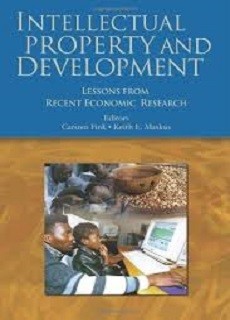
Intellectual Property and Development: Lessons from Recent Economic Research
0
0
As an Amazon Associate and affiliate partner, Menrva Books earns from qualifying purchases. Learn more
Author Description
In the mid-1990s, the World Trade Organization developed the Agreement on Trade-Related Aspects of Intellectual Property Rights (TRIPS), which sets out minimum standards of IPR protection. The World Bank has held keen interest in better understanding how well-designed intellectual property policies can help foster development and reduce poverty. This volume brings together studies conducted by World Bank or Bank-affiliated economic researchers who seek to better understand the economic underpinnings of the different degrees and forms of IPR protection."--Jacket.
Menrva's Summary
THE THESIS
This volume investigates the economic implications of intellectual property rights (IPR) protection, particularly in the context of fostering development and reducing poverty. The book compiles studies by World Bank and affiliated economic researchers, examining the economic underpinnings of varying degrees and forms of IPR protection. It addresses the period following the mid-1990s development of the WTO's TRIPS agreement, which established minimum IPR standards. The research aims to provide a better understanding of how well-designed intellectual property policies can contribute to economic growth and poverty alleviation.
THE SCOPE MAP
- Analysis of the economic effects of intellectual property rights (IPR) protection.
- Studies conducted by World Bank or Bank-affiliated economic researchers.
- Examination of the relationship between IPR policies and fostering development.
- Research on how IPR can contribute to poverty reduction.
- Discussion of the economic underpinnings of different IPR protection levels.
- Contextualization within the framework of the WTO's TRIPS agreement.
THE AUTHORITY PERSPECTIVE
This collection of studies, originating from World Bank researchers, offers an in-depth economic analysis of intellectual property rights (IPR) in relation to development. The research focuses on empirical evidence and economic modeling to understand the impact of IPR policies on poverty reduction and economic growth. The book is positioned as a resource for policymakers and academics interested in the practical economic consequences of intellectual property frameworks.
Page Count:
339
Publication Date:
2005-01-01
ISBN-10:
0821357727
Non-Fiction
Economics
Business
Intellectual Property
Research
International Trade
Community Tags
Similar Books