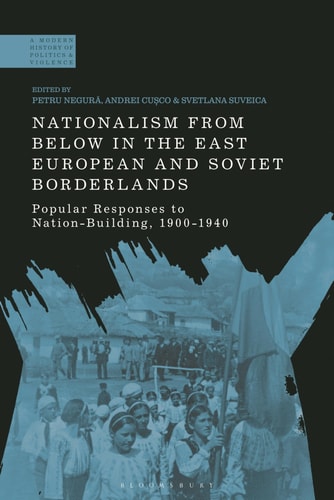
Nationalism From Below in the East European and Soviet Borderlands Popular Responses to Nation-Building, 1900-1940
0
0
As an Amazon Associate and affiliate partner, Menrva Books earns from qualifying purchases. Learn more
Author Description
This book features contributions that examine the responses of local populations to nationalizing and state-building projects in the first half of the twentieth century. Focusing on bottom-up, peripheral, and marginal reactions to top-down nation-building efforts, the volume covers border regions of Romania, Austria-Hungary (before 1918), Poland, Finland, the Russian Empire, and the USSR between 1900 and 1940. Historiography continues to privilege top-down approaches, focused on elites, institutions, and official policies. Despite previous notable works on this topic, in-depth studies of bottom-up perspectives on these regions remain rare. This volume seeks to redress the imbalance by emphasizing the perceptions, discourses, and everyday practices of ordinary people confronted with (often repressive) nation- and state-building agendas. It also addresses multiple levels of social interaction (combining perspectives from above, from below, and from the middle), involving several categories of actors and navigating through different scales of analysis. Individual and comparative case studies explore the social and political peculiarities of various local communities, particularly their evolving forms of national identification across neighboring regions. This volume contributes to both nationalism studies, by critically engaging with the concepts of everyday ethnicity and “national indifference,” and borderland studies, through a trans-sectional approach focusing on the agency of various marginalized communities.
Page Count:
320
Publication Date:
2025-12-11
Publisher:
Bloomsbury Academic
ISBN-10:
1350443751
ISBN-13:
9781350443754