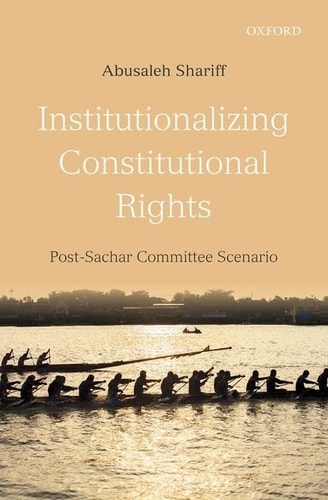
Institutionalizing Constitutional Rights: Post-Sachar Committee Scenario
0
0
As an Amazon Associate and affiliate partner, Menrva Books earns from qualifying purchases. Learn more
Author Description
A fundamental shift in political discourse in India was achieved when 'The Social, Economic, and Educational Status of the Muslim Community of India: A Report' was presented to the Government of India. Popularly known as the Sachar Committee Report, it brought to light the fact that Muslims were the most deprived and backward socio-religious community in India on almost all fronts of social and economic development. As a response to the report, a series of pro-poor and inclusive policies were initiated by the central and state governments, which were criticized for being less comprehensive and inclusive than those recommended by the committee.This book is an attempt to assess and evaluate these 'post-Sachar' policies through a number of empirical analyses studying socio-economic aspects of development among socio-religious minorities, specifically Muslims. Bridging the gap in documentation, analysis, and publicizing of impact of post-Sachar policies and their associated national and state government programmes, this book identifies policies and institutions required for ensuring the constitutional right to equal opportunity of all Indian citizens, specially minorities. It also makes suggestions towards improving the process of inclusion of such minorities into the national mainstream.
Menrva's Summary
THE THESIS
This book investigates the efficacy and implementation of post-Sachar Committee policies aimed at addressing the socio-economic deprivation of the Muslim community in India. Author Abusaleh Shariff, a noted economist and researcher, utilizes empirical data to evaluate the impact of government programs initiated following the 2006 Sachar Committee Report. The work provides a critical framework for understanding how institutional mechanisms can be better aligned with the constitutional mandate of equal opportunity for all citizens, particularly marginalized socio-religious minorities.
THE SCOPE MAP
What You Will Find
- Empirical analysis of socio-economic development indicators among Indian Muslims.
- Evaluation of government-led inclusive policies and pro-poor programs implemented post-2006.
- Identification of institutional gaps in the delivery of constitutional rights.
- Policy recommendations for improving the integration of minorities into the national mainstream.
THE AUTHORITY PERSPECTIVE
Experts recognize this work as a significant contribution to the study of minority development and public policy in India. Readers frequently note the technical rigor of the empirical analysis, making it a valuable resource for policymakers and scholars focused on social justice and institutional reform.
Page Count:
540
Publication Date:
2016-04-25
Publisher:
Oxford University Press
ISBN-10:
0199461155
ISBN-13:
9780199461158
Economics
India
Public Policy
Muslims india
Sociology
Minority Studies
Community Tags
Similar Books