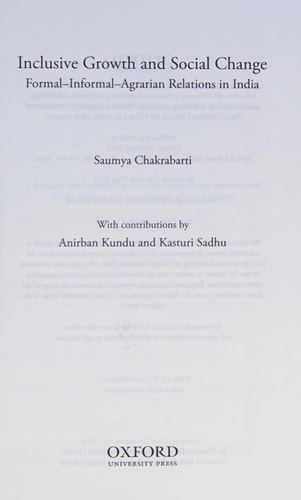
Inclusive Growth and Social Change: Formal-Informal-Agrarian Relations in India
0
0
As an Amazon Associate and affiliate partner, Menrva Books earns from qualifying purchases. Learn more
Author Description
Has the Indian economy realized its oft-stated goal of inclusive growth? Did the rapid progress made after liberalization help improve income levels of the most vulnerable households in the country? Can the economy succeed in establishing complementary linkages between the formal and informal sectors so that the growth of the former enables the latter?What can be the role of agriculture in this context?This book addresses such debates, and posits that, despite the consistently high growth rate driven by the formal sector, informality exists without substantial improvement in its basic economic conditions. It explores the conflicts and complementarities between both segments of the economy arguing that these interactions lead to a distorted structure of capitalism.With in-depth theoretical foundations and empirical analysis, the book interrogates the paradigm of 'growth' being 'inclusive', proposing that only a comprehensive structural change can resolve the challenges of the informal sector.
Menrva's Summary
THE THESIS
This book investigates whether India's post-liberalization economic growth has successfully achieved inclusivity or if it has instead perpetuated structural inequality between formal and informal sectors. Saumya Chakrabarti, an expert in development economics, utilizes a combination of rigorous theoretical frameworks and empirical data to examine the disconnect between high national growth rates and the stagnant economic conditions of vulnerable households. The author argues that the current model of capitalism in India is fundamentally distorted, necessitating a comprehensive structural shift rather than incremental policy adjustments to address the systemic challenges faced by the informal and agrarian sectors.
THE SCOPE MAP
What You Will Find
- Analysis of the formal and informal sector dichotomy within the Indian economy.
- Theoretical exploration of the distorted structure of Indian capitalism.
- Empirical assessment of income levels among vulnerable households post-liberalization.
- Evaluation of the role of agriculture in facilitating or hindering inclusive growth.
THE AUTHORITY PERSPECTIVE
Scholars and economists recognize this work as a critical contribution to the discourse on Indian development policy and structural inequality. Readers frequently note the academic density of the prose, which makes it a foundational text for those studying the complexities of the informal economy.
Page Count:
656
Publication Date:
2016-08-01
Publisher:
Oxford University Press
ISBN-10:
0199466068
ISBN-13:
9780199466061
Economics
Agriculture
India
Country Life
Social change
Community Tags
Similar Books