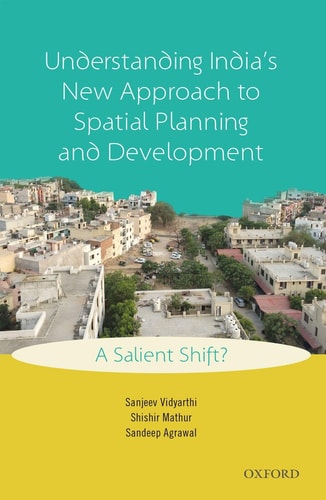
Understanding India's New Approach to Spatial Planning and Development: A Salient Shift?
0
0
As an Amazon Associate and affiliate partner, Menrva Books earns from qualifying purchases. Learn more
Author Description
Is there a political and economic struggle when it comes to spatial development and planning of India's urban and rural landscapes? This book brings together the ongoing shift in India's approach to spatial planning and development in line with changes in the country's polity. Taking the regime change in the early 1990s as a point of departure, it focuses on transformations in the distinct, but interrelated, domains of infrastructure finance and development, local spatial planning practice, and on-the-ground empirical outcomes.Instead of covering large cities-such as Kolkata, Mumbai, and Delhi-that dominate the discourse on urban India, the authors pay close attention to fine-grained aspects of the shift away from the well-theorized Nehruvian planning and development model. The innovative approach helps illustrate how the tensions between democratic and market-oriented impulses shape India's existing and emergent settlements in a manner that could be uneven and largely invisible while drawing out useful insights for scholars and practitioners working in the field.
Menrva's Summary
THE THESIS
This book investigates whether the transition from the Nehruvian planning model to a market-oriented framework represents a fundamental shift in India's spatial development and political economy. The authors, Sandeep Agrawal, Sanjeev Vidyarthi, and Shishir Mathur, utilize a comparative analysis of post-1990s policy changes to evaluate how shifting political regimes influence infrastructure finance and local planning practices. By moving beyond the focus on major metropolitan centers, the text provides a rigorous examination of the tensions between democratic governance and market-driven development in diverse Indian settlements.
THE SCOPE MAP
What You Will Find
- Analysis of the transition from Nehruvian planning models to contemporary market-oriented frameworks.
- Examination of infrastructure finance mechanisms and their impact on local spatial development.
- Empirical case studies focusing on smaller, non-metropolitan settlements rather than major cities like Delhi or Mumbai.
- Assessment of the uneven outcomes resulting from the interplay between democratic impulses and market-driven urban growth.
THE AUTHORITY PERSPECTIVE
Experts identify this work as a critical contribution to the study of Indian urbanism, particularly for its focus on secondary cities and the nuances of policy implementation. Readers frequently note the academic density of the prose, which serves as a valuable resource for scholars and practitioners analyzing the intersection of politics and spatial planning.
Page Count:
298
Publication Date:
2017-09-06
Publisher:
Oxford University Press
ISBN-10:
0199472645
ISBN-13:
9780199472642
City Planning
Public Policy
India
urban planning
Urban policy
Geography
Community Tags
Similar Books