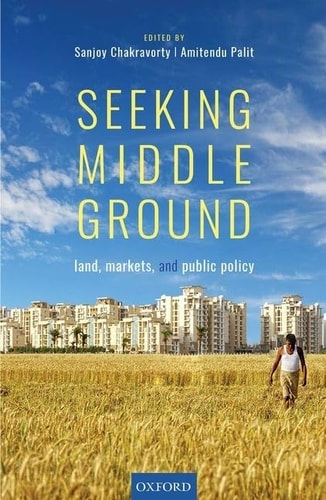
Seeking Middle Ground: Land, Markets, and Public Policy
0
0
As an Amazon Associate and affiliate partner, Menrva Books earns from qualifying purchases. Learn more
Author Description
Land is a subject of great conflict and debate in India. Over the past decade, the debate has focused on land acquisition, which some have called India's biggest problem. Land and the issues related to its acquisition have heavily influenced electoral verdicts and political fortunes in various parts of India. A new law for acquisition was created by the left-of-center Congress-led UPA government in 2013, which was immediately sought to be amended (unsuccessfully) in 2014 by the newly elected right-wing BJP-led NDA government. These differing visions on acquisition have often been simplified into opposing camps: people-friendly vs. business-friendly; "populist vs.neoliberal". Much of the general discourse on land remains similarly polarized.At the core of the debate are serious issues of justice and history intertwined with politics and economics. These debates over land are already prominent in contemporary India and are expected to become even more so in the coming decade given the anxieties over rural distress and the problem of livelihoods. Social, economic, and political turmoil over land will become more visible as India struggles to address the serious challenges of satisfying the aspirations of a burgeoning young population with growing lack of work. As land-based incomes stagnate or dwindle for rural communities and alternative earning options remain vague and limited, while changing land use from agriculture to more productive alternatives remains fraught with conflict, popular politics and public policies in India will have to stay engaged with the debate on land at their core.
Menrva's Summary
THE THESIS
This book investigates the complex intersection of land acquisition, economic development, and political policy in contemporary India. The authors, Amitendu Palit and Sanjoy Chakravorty, utilize a multidisciplinary approach to examine how land-related conflicts shape national electoral outcomes and rural livelihoods. By analyzing the legislative shifts between the UPA and NDA governments, the text argues that the binary framing of 'populist versus neoliberal' policies fails to capture the nuanced reality of land justice and economic necessity in a developing nation.
THE SCOPE MAP
What You Will Find
- Analysis of the 2013 Land Acquisition Act and subsequent 2014 amendment attempts.
- Examination of the socio-economic impact of transitioning land use from agriculture to industrial alternatives.
- Evaluation of rural distress and the limitations of current employment opportunities for a young population.
- Assessment of the political discourse surrounding land rights and market-driven development.
THE AUTHORITY PERSPECTIVE
Experts identify this work as a critical resource for understanding the structural tensions within Indian political economy. Readers frequently note the clarity with which the authors navigate the dense legal and historical landscape of land policy.
Page Count:
308
Publication Date:
2019-11-03
Publisher:
Oxford University Press
ISBN-10:
0199495459
ISBN-13:
9780199495450
Economics
India
Land tenure
Land Use
Public Policy
Sociology
Community Tags
Similar Books