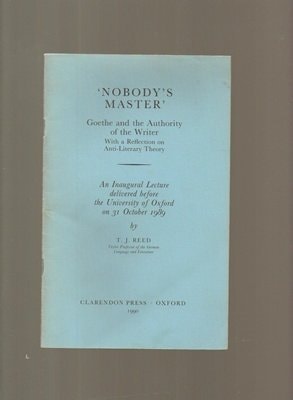
Nobody's Master: Goethe and the Authority of the Writer, With a Reflection on the Anti-Literary Theory
0
0
As an Amazon Associate and affiliate partner, Menrva Books earns from qualifying purchases. Learn more
Author Description
Professor T.J.Reed delivered his inaugural lecture before the University of Oxford on 31 October 1989. Professor Reed's argument starts from Goethe's suprising late disclaimer of the authority of a master, and then traces from his literary beginnings the process by which the young writer's self-confidence and authority to speak are grounded in his physical and psychological experience, strengthened by communion with past writers, and shaped into an original communicative language. Against the view that in his day he was an "authority" (an authoritarian figure, even) the evidence shows his growing commitment to a literary forum where freedom of communication matters more than individual position. The belief in, and practice of, literature as a viable means of communication, in which the initiative of individual writers is vital, constitute Goethe's true authority. This is set against recent attempts by theorists to undermine the whole working system of literature. Their fundamental lovelessness is diagnosed and the resistance to theory of those who love literature is justifed.
Menrva's Summary
THE THESIS
This work investigates the nature of literary authority by examining Johann Wolfgang von Goethe’s rejection of the 'master' label in favor of literature as a communicative forum. Terence James Reed, a distinguished scholar of German literature, utilizes Goethe’s personal development and historical context to argue that true authority stems from the writer's commitment to free communication rather than authoritarian posturing. The text contrasts this historical perspective with contemporary anti-literary theories, which Reed critiques for their perceived detachment from the creative process.
THE SCOPE MAP
What You Will Find
- An analysis of Goethe’s evolution from a self-confident young writer to a mature literary figure.
- A historical examination of the 18th and 19th-century literary landscape.
- A critical rebuttal of modern theoretical frameworks that seek to dismantle the traditional literary system.
- An exploration of the relationship between individual writer initiative and communal discourse.
THE AUTHORITY PERSPECTIVE
Scholars and students of German studies frequently cite this lecture as a concise yet potent defense of traditional literary values against post-structuralist critiques. Readers often note the academic density of the prose, which reflects the author's deep familiarity with Goethean scholarship and his firm stance within the field of literary theory.
Page Count:
34
Publication Date:
1600-01-01
Publisher:
Clarendon Pr
ISBN-10:
0199513457
ISBN-13:
9780199513451
Philosophy
Biography
Literary Criticism
Literature
European
Authorship
German
Community Tags
Similar Books