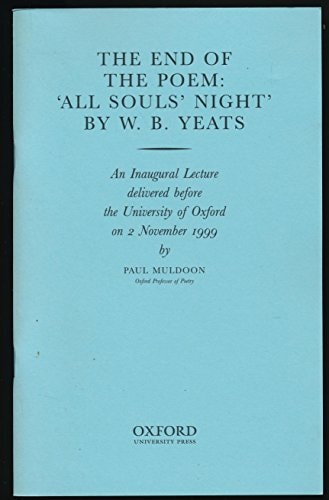
The End of the Poem: All Souls' Night by W.B. Yeats
0
0
As an Amazon Associate and affiliate partner, Menrva Books earns from qualifying purchases. Learn more
Author Description
In The End of the Poem, Paul Muldoon, “the most significant English-language poet born since the Second World War” ( The Times Literary Supplement ), presents engaging, rigorous, and insightful explorations of a diverse group of poems, from Yeats’s “All Souls’ Night” to Stevie Smith’s “I Remember” to Fernando Pessoa’s “Autopsychography.” Here Muldoon reminds us that the word “poem” comes, via French, from the Latin and “a thing made or created.” He Can a poem ever be a freestanding, discrete structure, or must it always interface with the whole of its author’s bibliography—and biography? Muldoon explores the boundlessness, the illimitability, created by influence, what Robert Frost meant when he insisted that “the way to read a poem in prose or verse is in the light of all the other poems ever written.” And he writes of the boundaries or borders between writer and reader and the extent to which one determines the role of the other. At the end, Muldoon returns to the most fruitful, and fraught, aspect of the phrase “the end of the poem”: the interpretation that centers on the “aim” or “function” of a poem, and the question of whether or not the end of the poem is the beginning of criticism. Irreverent, deeply learned, often funny, and always stimulating, The End of the Poem is a vigorous and accessible approach to looking at poetry anew.
Menrva's Summary
THE THESIS
Can a poem exist as a discrete, freestanding structure, or is it inextricably bound to the author's biography and the broader history of literature? Paul Muldoon, a distinguished poet and academic, utilizes his inaugural lecture series to examine the mechanics of poetic influence and the porous boundaries between creator and reader. He argues that poems function as interconnected artifacts, suggesting that the conclusion of a poem serves as the natural starting point for critical inquiry. By analyzing specific works, Muldoon interrogates the intent and function of poetic creation within the context of literary tradition.
THE SCOPE MAP
What You Will Find
- Close readings of specific poems by W.B. Yeats, Stevie Smith, and Fernando Pessoa
- Theoretical frameworks regarding the influence of Robert Frost on poetic interpretation
- Analysis of the etymological roots of the word poem as a thing made or created
- Exploration of the intersection between an author's bibliography and their personal biography
THE AUTHORITY PERSPECTIVE
Critics and scholars frequently note the accessibility and wit Muldoon brings to these rigorous literary investigations. The text is widely regarded as a valuable resource for students of poetry who seek to understand the complex relationship between creative output and critical reception.
Page Count:
32
Publication Date:
2000-01-01
Publisher:
Oxford Univ Pr
ISBN-10:
0199513953
ISBN-13:
9780199513956
Poetry
Non-Fiction
Literary Criticism
Essays
Community Tags
Similar Books