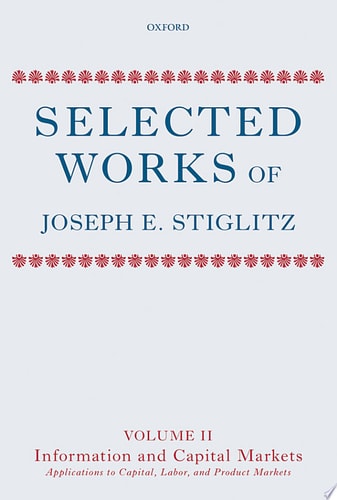
Selected Works of Joseph E. Stiglitz: Volume II: Information and Economic Analysis: Applications to Capital, Labor, and Product Markets
0
0
As an Amazon Associate and affiliate partner, Menrva Books earns from qualifying purchases. Learn more
Author Description
This is the second of six volumes in a series of selected scientific papers by one of the world's most distinguished economists. Volume I presented the basic concepts in the Economics of Information, showing that markets in which information was imperfect or asymmetric (where some individuals know things that others don't) behave markedly different from how they would if information were perfect. Volume II, with papers written between 1969 and 2009, explores the implications of the New Information Paradigm for labor, capital, and product markets. This New Paradigm, for which Stiglitz was awarded the Nobel Memorial Prize in Economics in 2001, has fundamentally changed the way we think about every aspect of economics, raising new questions on corporate governance, and leading us to reconsider old questions on corporate finance, the relationship between finance and the economy, and the theory of economic incentives.While this volume focuses on the application of basic principles, it also extends the theory in important ways, showing the fruitfulness of Stiglitz's research strategy. In doing so, the papers set the ground for questioning some prevailing doctrines: key market phenomena cannot be explained by markets with rational expectations, even when information is imperfect. It demonstrates that how societies organize the obtainment, processing, and transmitting of information is as important as how they organize the production and distribution of goods. Indeed, the two issues are inseparable. The papers thus lay the foundations of a New Institutional Economics, not only describing how institutions (like sharecropping or banks) work and affect resource allocations, but why they arise and take on particular forms.
Menrva's Summary
THE THESIS
This volume investigates how the presence of imperfect and asymmetric information fundamentally alters the mechanics of labor, capital, and product markets. Joseph E. Stiglitz, a Nobel Memorial Prize laureate, compiles research papers spanning four decades to demonstrate that traditional economic models relying on perfect information fail to explain key market phenomena. By applying the New Information Paradigm, the author provides a framework for understanding corporate governance, finance, and the formation of economic institutions.
THE SCOPE MAP
What You Will Find
- Analysis of market behavior under conditions of asymmetric information between 1969 and 2009.
- Theoretical applications to corporate finance, sharecropping, and banking structures.
- Research papers examining the intersection of information processing and resource allocation.
- Foundations for a New Institutional Economics that explains why specific economic institutions arise.
THE AUTHORITY PERSPECTIVE
Experts recognize this collection as a foundational resource for understanding the evolution of modern information economics. Readers frequently note the high level of technical rigor and the significant influence these papers have had on contemporary economic policy and institutional theory.
Page Count:
904
Publication Date:
2013-05-05
Publisher:
Oxford University Press
ISBN-10:
0199533717
ISBN-13:
9780199533718
Economics
Economic Theory
Academic
Finance
Community Tags
Similar Books