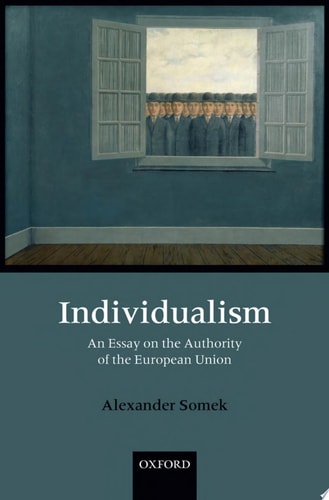
Individualism: An Essay on the Authority of the European Union
0
0
As an Amazon Associate and affiliate partner, Menrva Books earns from qualifying purchases. Learn more
Author Description
This innovative study examines the authority constituting the European Union. It claims that the type of power constituting a transnational regime transcends traditional forms of constitutional legality. It argues that the European constitutional project is out of step with the normative make-up of such a regime. It is to be feared, indeed, that the adoption of a Constitution for Europe would create a smokescreen obscuring a new and disturbing reality.Drawing on the ancient tradition of linking different types of political power with the composition of the citizen's soul, the book explains that a transnational regime is based on an understanding of citizenship that is different from that underlying a constitutional democracy. Citizens are deemed to be essentially separate from one another. They abandon the larger society to itself and pursue their good in the private sphere. In place of trust and reliance in their own power to bring about change through common action, they hope to benefit from entrusting "problem-solving" to international networks of expertise. Essentially, citizens of this kind exhibit a strong commitment to individualism.The book shows how individualism is reflected in the regulatory authority that the Union claims for itself, in particular as regards the regulation of the internal market.
Menrva's Summary
THE THESIS
This study investigates whether the European Union's transnational authority structure is fundamentally incompatible with the principles of traditional constitutional democracy. Alexander Somek, a legal scholar, utilizes political philosophy and constitutional theory to argue that the European project relies on a specific, atomized form of citizenship that prioritizes private interest over collective political action. He contends that this shift toward technocratic problem-solving obscures the true nature of power within the Union, suggesting that the drive for a formal constitution may be a misdirected effort that fails to address the underlying normative disconnect.
THE SCOPE MAP
What You Will Find
- Analysis of the shift from constitutional democracy to transnational regulatory regimes.
- Philosophical examination of the citizen's role and the concept of the soul in political power.
- Critique of the internal market regulation as a manifestation of modern individualism.
- Evaluation of the risks associated with replacing democratic trust with international networks of expertise.
THE AUTHORITY PERSPECTIVE
Legal scholars and political theorists frequently cite this work for its rigorous critique of European integration and its philosophical depth. Readers often note the academic density of the prose, which requires a strong background in constitutional law and political theory to fully navigate the author's arguments.
Page Count:
336
Publication Date:
2008-06-02
Publisher:
Oxford University Press
ISBN-10:
0199542082
ISBN-13:
9780199542086
Philosophy
Nationalism
Citizenship
Sociology
Individualism
Law
European Union
Community Tags
Similar Books