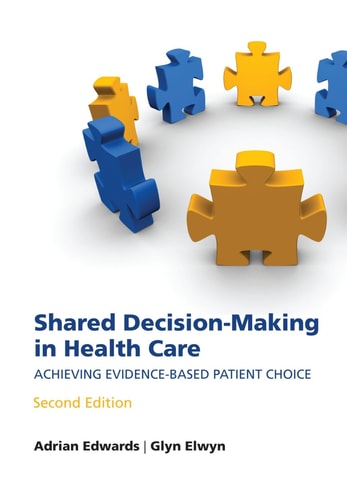
Shared Decision-Making in Health Care: Achieving Evidence-Based Patient Choice
0
0
As an Amazon Associate and affiliate partner, Menrva Books earns from qualifying purchases. Learn more
Author Description
When the first edition of this book came out in 2001, it examined the emerging themes of patient choice and clinical decision-making, and looked at how these might develop in the future. Since then, these issues have become even more topical. Evidence-based medicine is deeply ingrained in the practice of modern medicine, while patient choice is increasingly high on the political agenda. But can the two trends co-exist? "Shared Decision Making" has developed in response to the sometimes uneasy relationship between a patient's right to have input into their treatment options, and a clinician's responsibility to provide the best evidence-based health care. Imagine a patient with osteoarthritis in her knee. She and her doctor are considering whether she would benefit from surgery to replace her knee joint. This sort of decision is typical of many in health care where there is more than one reasonable alternative available to the patient and her doctor. These alternatives include surgery, physiotherapy, medication, complementary remedies, and more. What is right for one patient may be different from what is right for another. Clinical information (such as results of x-rays or even patient-reported symptom score) though necessary, is not sufficient to determine the best treatment.
Menrva's Summary
THE THESIS
This book investigates the complex intersection between evidence-based medical practice and the increasing demand for patient-centered choice in health care. Adrian Edwards, a prominent researcher in the field of shared decision-making, examines the tension between clinical responsibility and patient autonomy. He argues that clinical data alone is insufficient for determining optimal treatment paths, proposing a framework where clinicians and patients collaborate to integrate scientific evidence with individual patient values and preferences.
THE SCOPE MAP
What You Will Find
- Analysis of the historical evolution of patient choice in clinical settings.
- Methodologies for balancing clinical evidence with diverse patient treatment options.
- Case studies illustrating decision-making processes for conditions like osteoarthritis.
- Frameworks for navigating the relationship between physician responsibility and patient input.
THE AUTHORITY PERSPECTIVE
Experts recognize this work as a foundational text for understanding the practical application of shared decision-making in modern clinical environments. Readers frequently note the clarity with which the author addresses the challenges of integrating patient preferences into evidence-based medical protocols.
Page Count:
414
Publication Date:
2009-06-29
Publisher:
Oxford University Press
ISBN-10:
0199546274
ISBN-13:
9780199546275
Decision Making
Evidence Based Medicine
Medicine
Physician & Patient
Health Care
Consent law
Community Tags
Similar Books